New Zealand was one destination I had really hyped up in my head going into it. Here’s how it compared to those expectations.

New Zealand was one destination I had really hyped up in my head going into it. Here’s how it compared to those expectations.

“The work you put in when no one is around always comes to light when you’re in front of thousands.”
–Tyrese Maxey
Welcome back to the NBA despite the very awkward start to the season. I just watched Kyle Schwarber’s guest spot on Abbott Elementary and now I’m thinking Tyrese Maxey would be a fantastic feature as well.

And we should shine a light on
And the book of right-on's right on
It was right on
I’ve been playing with my visual style, letting it evolve lately. My recent stuff looks so different but I’ve been enjoying making it so much more.
Recently got the flight number ONE.
UA1️⃣ SFO ✈️ SINGAPORE
Made me wonder about other flight number ones and other interesting flight numbers… so I dove in deep!
I hadn’t been in New Zealand for very long when I decided New Zealanders might be the funniest batch of people on Earth.
You know how isolated islands lead to all kinds of quirky species evolve? Like Tasmania or the Galapagos? Something similar must be happening with humor over in New Zealand.
New Zealand has a rather large profile when it comes to comedy, especially relative to its size. Taika Waititi is currently its most known entity. His popularity follows that of Flight of the Concords. You can find Kiwi sensibility all over their work. Yet, to best appreciate New Zealand’s wit, you need to take things down to a street level.
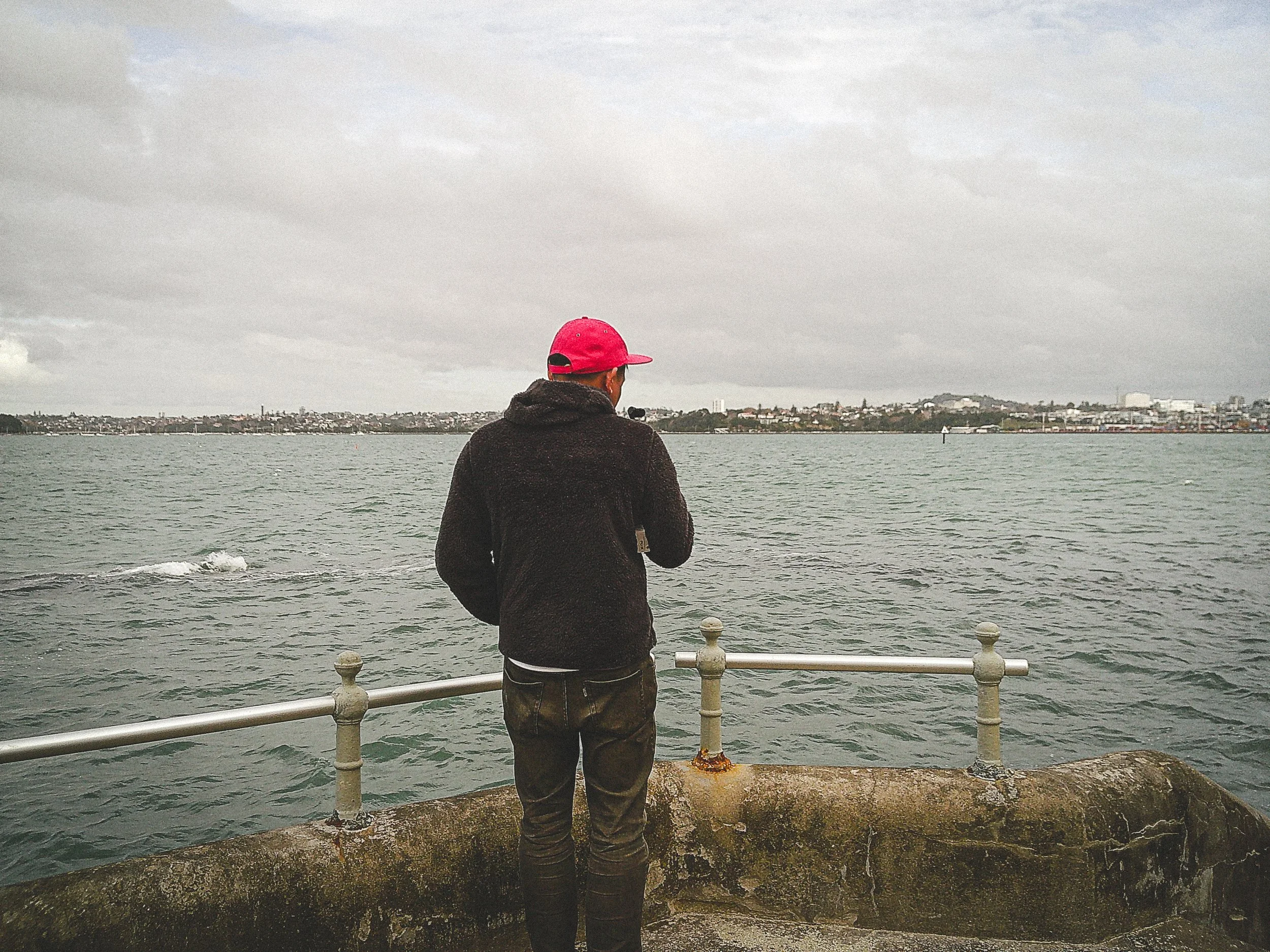
Much like their neighbors in Australia, New Zealand jokes fit the Tall Poppy Syndrome. It’s rooted in a culture that values egalitarianism. It’s what happens when someone starts to achieve a ton of success. When they start to stand out, it’s the duty of their peers to ‘cut them down to size.’
Barbs and roasts are a pretty good way to trim those “tall poppies.”
In comedy terms, you often hear this described as “punching up.” But in New Zealand, it’s often applied among peers than in a revolutionary sense of “speaking truth to power.”
In that regard, no one of Taika Waititi’s pedigree could be a complete ambassador of New Zealand’s funny side. I love most of his movies, but it’s hard not to see him as the current tall poppy in the field.
It goes without saying that the best way to get to know and appreciate New Zealand’s humor is at a street level. It’s in the subtle chuckle of a bus driver when a tour group is too serious. It’s in the self deprecating admission of our wine tasting guide blurting out that he’s more of a beer guy.

It’s mischievous, understated, and revels in the awkwardness of social situations. The proper word is “cheeky.” What a fitting adjective. There’s a fine art to cheekiness that I envy.
For new explorers of comedy’s fault lines, The Office is a good starting point. The differences between the British and American versions, that is. Dry British humor catches so many of us Americans off guard. As a teenager, I discovered TriggerHappy TV. It was Britain’s take on a Candid Camera type show. I loved it, but there was something so blunt about its gags.
That was my first conscious encounter with different comedy cultures. But earlier exposure came via the land of my ancestry, the Philippines.

In the 1980s, a duo called Dolphy and Babalu were the Laurel and Hardy of the Philippines. Their comedy routines often involved a lot of shouting and running around. I still remember a bit when Dolphy (or was it Babalu? Who knows?) is trying to take a shower in a bathroom with a bunch of plumbing malfunctions. Around the same time, I was also introduced to Yoyoy Villame. Imagine the Philippines’ Weird Al. A maker of silly songs.
Filipino humor was as loud as New Zealand’s is subtle. But what it lacks in sophistication it makes up for with endearing sincerity. And there are some good explanations about why it’s like that.
On an archipelago with over 700 languages, slapstick and physical humor rule. They cover more ground than language based jokes. That said, Filipinos love wordplay and puns. It makes sense to me. With how much we love to sing, auditory experiences go far.
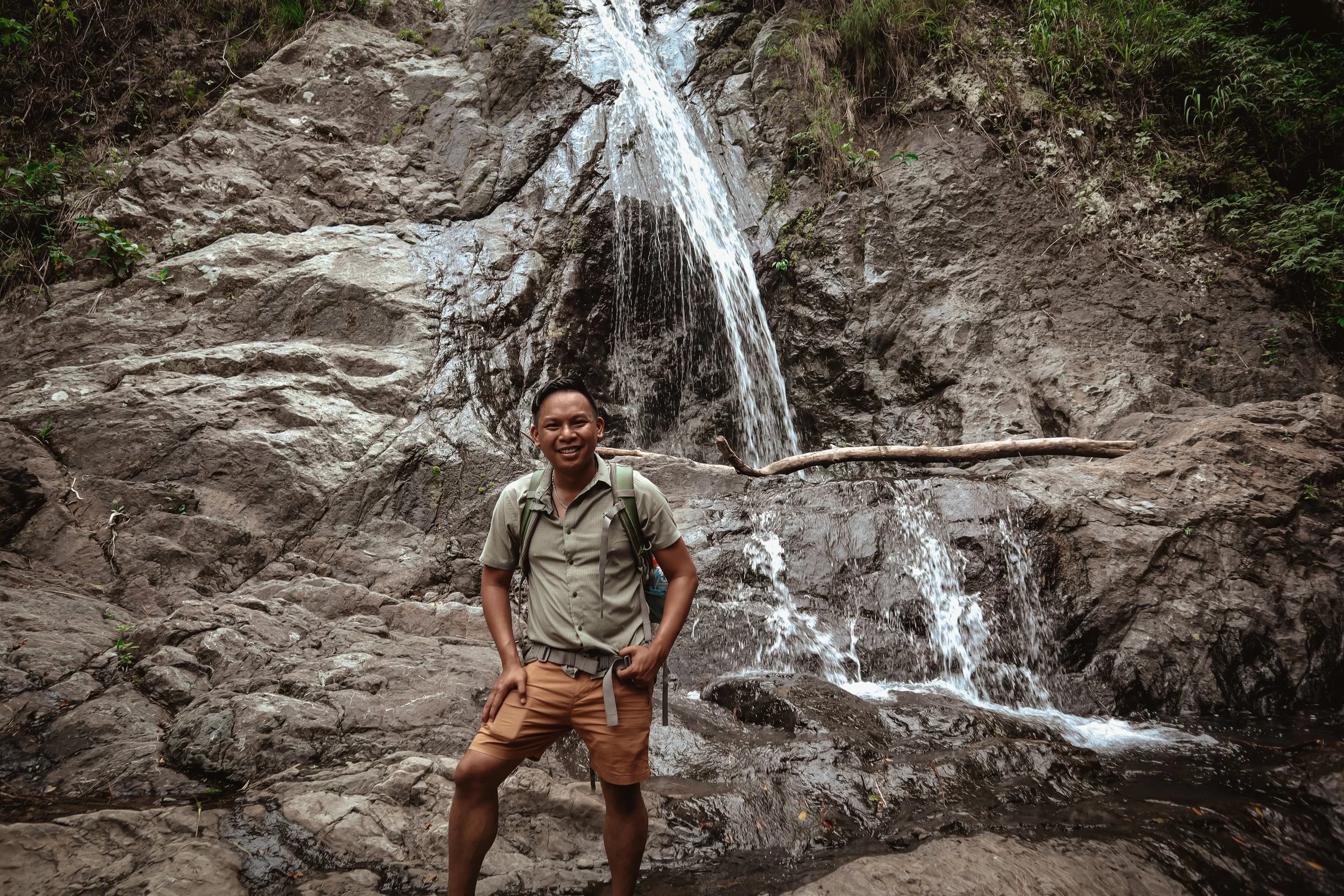
The country has seen its share of poverty, political turmoil, and natural disaster. With that in mind, humor can be a bit of a coping mechanism. Humor is a reflection of the national characteristic of being resilient, matiyaga. It helps to keep spirits up during crises.
It dawns on me that I have these insights because I have a direct link through my Filipino heritage. The settings are familiar to me. I understand Tagalog. And that makes me realize something. My grasp on the different comedic cultures of the world will always have limits. Comedy needs context. While I’ve been able to travel a lot, without the lived experience or language of a place… you won’t quite get it.
Sure. Every now and then we get a Mr. Bean or Khaby who can transcend those boundaries. But that happens like once in a generation.
(And yeah, I stand by my assertion that Khaby is the Gen Z Mr. Bean.)
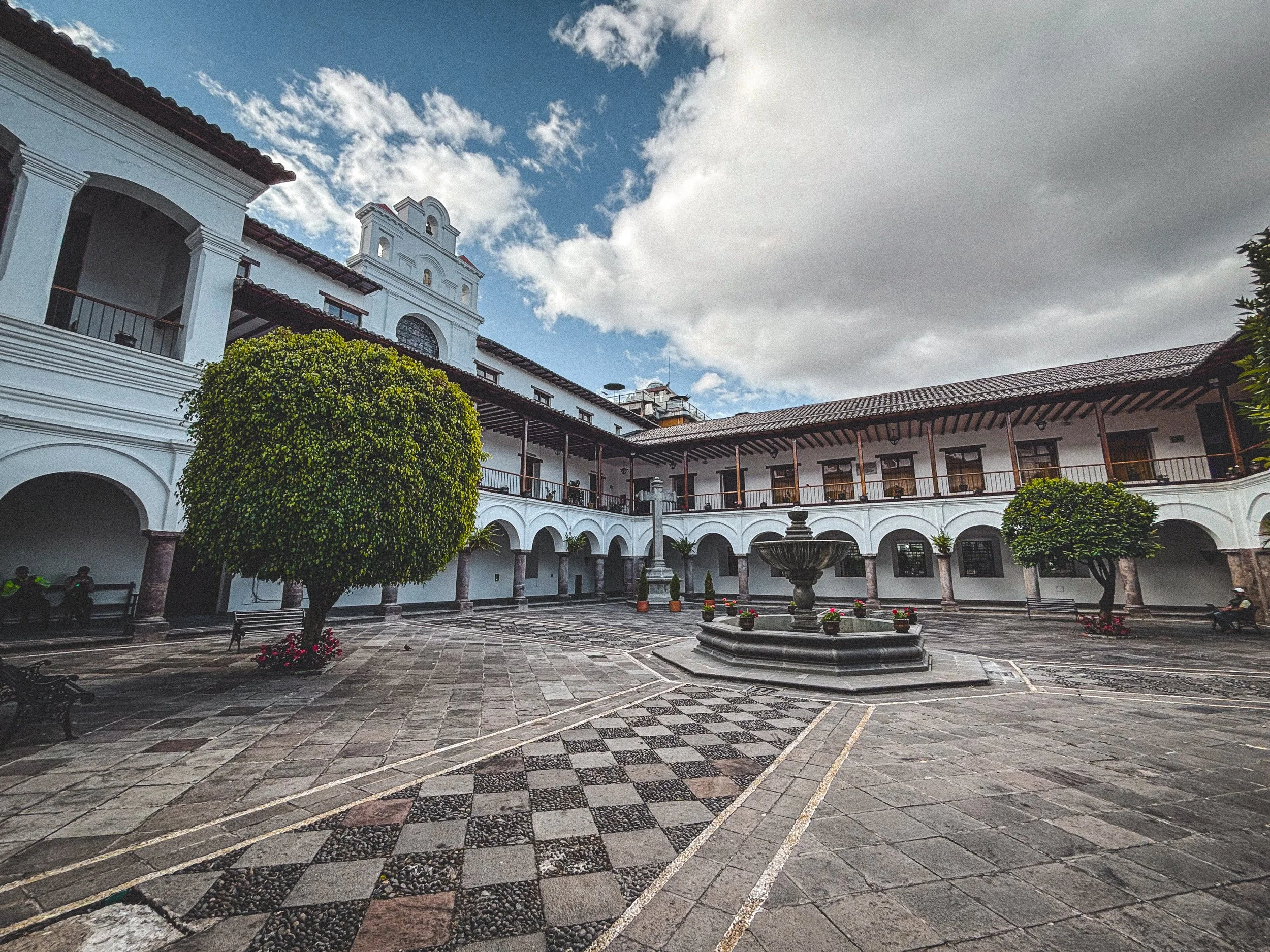
Spanish creates an interesting window. Spanish speaking countries vary quite a bit in how they approach humor. When I lived in Argentina, there was a sarcastic, cynical undertone to a lot of the joking. So much of it veered into politics. I love Argentina, but this is so different from my style. It’s so different from the lighthearted storytelling humor you find in Colombia. Or the playful, raunchy jokes of Mexico.
South Africa has one of the most fascinating relationships with comedy. At least that I’ve encountered. For starters, it has a patchwork of different influences. South Africa has seen drastic amounts of social change in recent history. So much comedy takes place in the awkward in-betweens of carving out a new normal.
The linguistic diversity of South Africa creates opportunity. It allows storytellers and comedians to take on different characters. Code switching mid-anecdote paints a picture. Playing with or subverting stereotypes challenges societal expectations. Many South African comedians have a skill at switching styles. They go between macro-political commentary and humor focused on mundane everyday moments.
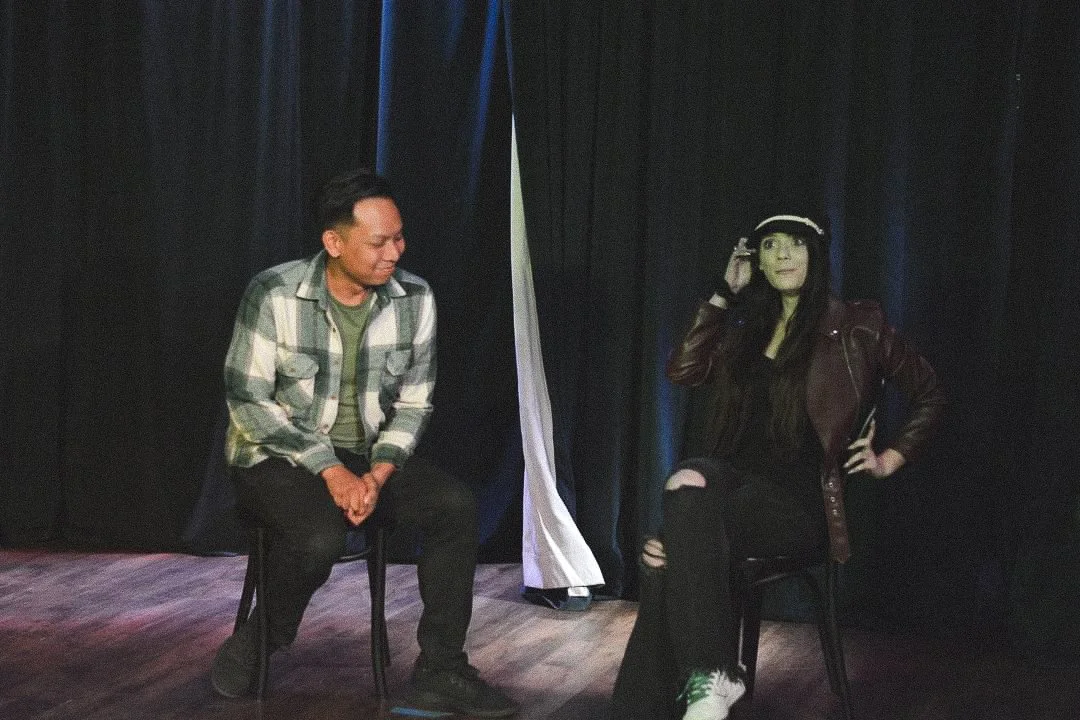
There are elements of that cheekiness I loved about New Zealand in South Africa as well. Is it a former British colony thing? A Southern Hemisphere thing? I don’t know. I do know I appreciate South African’s exaggerated responses. Responding to an absurd situation with a hearty shoooooo... That makes it that much more lively.
There’s no one way to be funny.
I’ve traveled a lot, and the crossroads of culture and humor remain mysterious.
I find it delightful and humbling.


This is possibly my favorite hotel. If you put eco-lodges and that sort of thing in another category, this might take the top spot. Definitely a top five.
The Observatory in Christchurch is modeled after Oxford. The whole city of Christchurch is named after a school in Oxford, so there’s a lot of school spirit going over there.
The location is about as good as it gets. It’s directly across the street from the city park and botanical garden, which is an excellent spot to spend hours outside. Walk ten minutes in the other direction and you’re at the river, right at the heart of the city, surrounded by all the good food.
The hotel only takes up the corner buildings of this section. The rest of the complex includes a wine bar, a pub, a paint-and-sip type place, a dance studio, and a full on cinema. You could spend a whole day just enjoying the site.
And inside the hotel, there’s a perfectly cozy drawing room where it feels like you’re supposed to do nothing but sip coffee and read.
A friend of mine became a true accidental influencer.
He was never the type to seek out a big internet following. He only sought to get a handful of followers. For work purposes. He made a handful of shortform videos, and a couple of them caught the fair winds of the algorithm. It was the perfect storm. Without much effort, he wound up with millions of followers in a matter of days.
He’s brilliant and creative, but even he would admit that this sort of came out of nowhere. And now it’s turned into an unintentional second job.
For the most part, his videos piggyback off of others’ conversations. He stitches on to other shortform videos and adds his insight.
“Of course, whenever I start my videos by yelling WRONG! they do well. Being aggressive always does a lot better than when I try to nuance things.
By this point, none of this is much of a surprise. It confirms what we already know.
The internet stirs up big feelings by design. The minds behind the apps know that nuance slows us down. Thoughtfulness leads to moderation. Anger and fear keep us coming back for more. Whenever posts deliver these, they’re destined to do well.
We live in the era of the hot take. And there’s no denying that it’s entertaining. It’s normal to start a conversation with your strongest, spiciest opinion.
It’s a structure that works very well with the way our brains’ design to process stories. And quite often, it uses that against us.
When our brains have to play defense, we’re less open. Less creative. Less effective at actual problem solving.
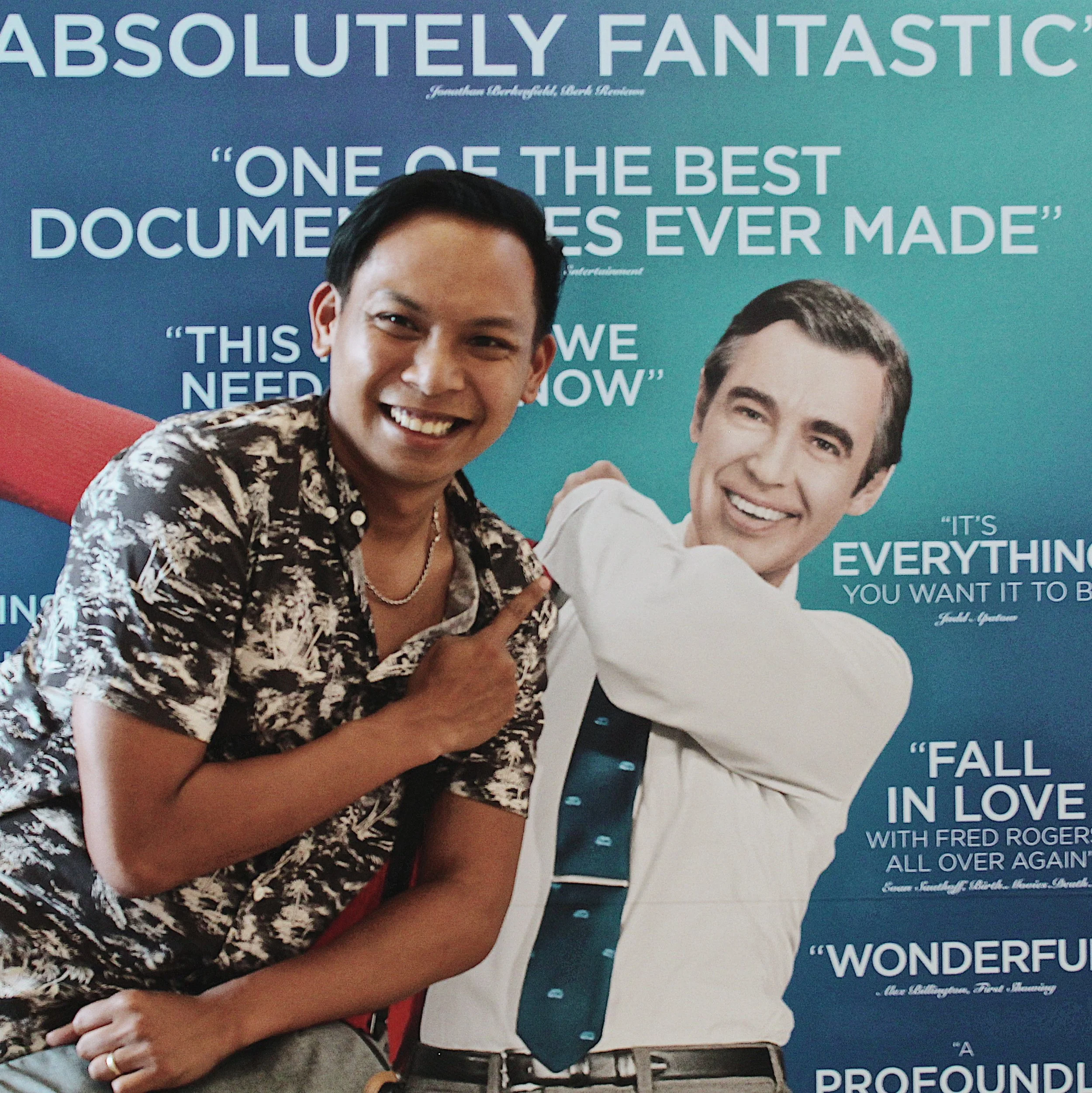
This reminds me of Fred Rogers. The rise of zany, slapstick children’s entertainment appalled him. It didn’t respect their developmental needs. While he was polite about “not naming any names.” But according to Maxwell King’s autobiography: “Fred abhorred violence. Even cartoon violence. He had no patience for slapstick. He believed that children needed slow, deliberate programming. He was unapologetic about the pace of his own show.”
So, no naming-and-shaming. Fred Rogers’ ultimate protest was the existence of his own show.
The deliberate pacing. The quiet music. The meaningful dialogue.
It was a form of quiet protest. Soft but strong. And its memory has outlived many of the shows he sought to contrast.
Of course I’m nowhere near Fred Rogers’ level. But the noise of incessant hot takes still makes me want to swing in the other direction.
I’ve seen so many articles and videos giving tips on how to drive up video view counts by stirring the pot. By starting with controversy. By flirting with ragebait. And straight up, I don’t want to play that game.
I’ve rejected a lot of these “best practices.” I’ll attract a smaller crowd, but I’d much rather have that than a crowd that turns out for drama.
The effects of living in a culture that amplifies the loudest voices are well documented.
Yes, we get a world where everyone’s angry all the time. Yes, we get a world where people gain influence by being loud.
People are capable of nuanced opinions. We don’t have to be walking caricatures of a particular worldview. But it’s common to only hear opinions the loudest and most extreme voices. That makes people pull back. Rational people retreat from conversations about important topics. The world becomes even more deprived of healthy dialogue.
I would like to live in a world of fewer hot takes.
But that doesn’t mean I want to live in a world of muzzled opinions.
I want points-of-view.
Those are different from hot takes. The difference is subtle but significant.
A point-of-view is a perspective. It contains opinions, sure, but it’s more than that. It’s a way of seeing the world.
When you’re prompted for a hot take, you’re asked for a strong opinion you have. An unpopular opinion, or one on a touchy subject.
But a point-of-view is more than an opinion. It’s a way of seeing the world.
This idea became clearer to me through improv. In improv, one of the most important things to establish in a scene is a character’s point-of-view. Without one, the characters and the scene will most likely flounder. A strong point-of-view invites goals, actions, choices, and reactions. Pick one and everything flows with ease. On stage, even a simple point-of-view can carry a scene.
This is one of those times where a skill you sharpen through improv applies quite well to the rest of life.
As you go through the world, know your POV.

On stage, once you’ve established a point of view and made it known to your scene partners, there’s a lot you can do. You can explore how having a particular point of view applies to different scenarios. Do you have a character whose point of view is to always be polite? How would they handle a career in professional wrestling? You can push that belief to its limits and the point of absurdity.
Another thing to do? Explore where that belief came from.
Does your character believe in always being polite because mom said so? Because they were a jerk before and they need to restore balance?
This is actually one of the biggest differences between a point-of-view and a hot take. Hot takes are cheap. People adopt them for sport.
But a point of view? It has an origin story. It comes from somewhere.
You aren’t shooting from the hip for the sake of having an opinion.
You’re drawing from an experience.
Because of this, it means your opinions aren’t colored by some other commentator’s words. They’re tied to values and beliefs that you embrace because of something you’ve gone through.
Imagine if our world was a lot less reactionary.
Imagine if whenever a bill was being passed and we didn’t look to our usual talking heads to see what they thought.
Imagine if a threat emerged and we didn’t pick our response based on political allegiance.
Instead, what if we ran those experiences through our biggest beliefs. Our decisions about what’s important in life. What matters at the end? How we’re supposed to relate to each other?
It might make the world less of a spectacle and more of a space to put our perspective into practice.
We live in a very loud, angry, and opinionated era. But I don’t think that our response should be to abandon our beliefs for the sake of civility. We need to dive deeper into them. See where they came from. See how they color what’s in front of us. See what we’re supposed to do next.
Hot takes are cheap.
A true point-of-view will actually ask something of you.

“There’s luck in the roll, but the rest is in how you respond. Sometimes, life gives you a bad throw but you can still win if you play it well. And of course, the big goal is to bring everybody home.”
Food content 🤝 Travel content 🤝 Dad content
If you know me, I’m always up for an adventure. There have been times where I was convinced that pursuing big quests was the “right way to live.” Then there were times that I thought growth and maturity looked like being so satisfied with simple things that you could spend 14 hours staring at a leaf and be happy.
These days I’m not so black and white on the matter. I’ve realized that a little thirst for adventure is just part of how I’m wired. It’s a good thing, especially when I focus on quality over quantity. AND I’ve also realized that there’s something really beautiful and true in being enchanted by the ordinary.
When my kids were two, two, and four, we took an ambitious family trip to Portugal and Spain. This was-without doubt-the most difficult set of ages for traveling. We’ve been going on international trips with kids as young as five months, but the age of two was a special challenge.
Not old enough to be potty trained, to have patience for long flights, and to keep outbursts minimal. Old enough to be very, very mobile.
Now that you know the context of our trip, let me emphasize: I am real glad we spent a week in Valencia.
Spanish culture is as laid back as it gets. That’s important to counterbalance the demand of traveling with kids. On top of that, Valencia has family-friendly infrastructure. It has plenty of playgrounds and so much good food.
Let me highlight all the reasons why Valencia is such an ideal destination. Especially with young kids. Here's what's worth checking out.
The Cidade des Artes e Ciencias alone might make Valencia worth the visit with kids.
Really? A science museum?
More like a museum of museums.
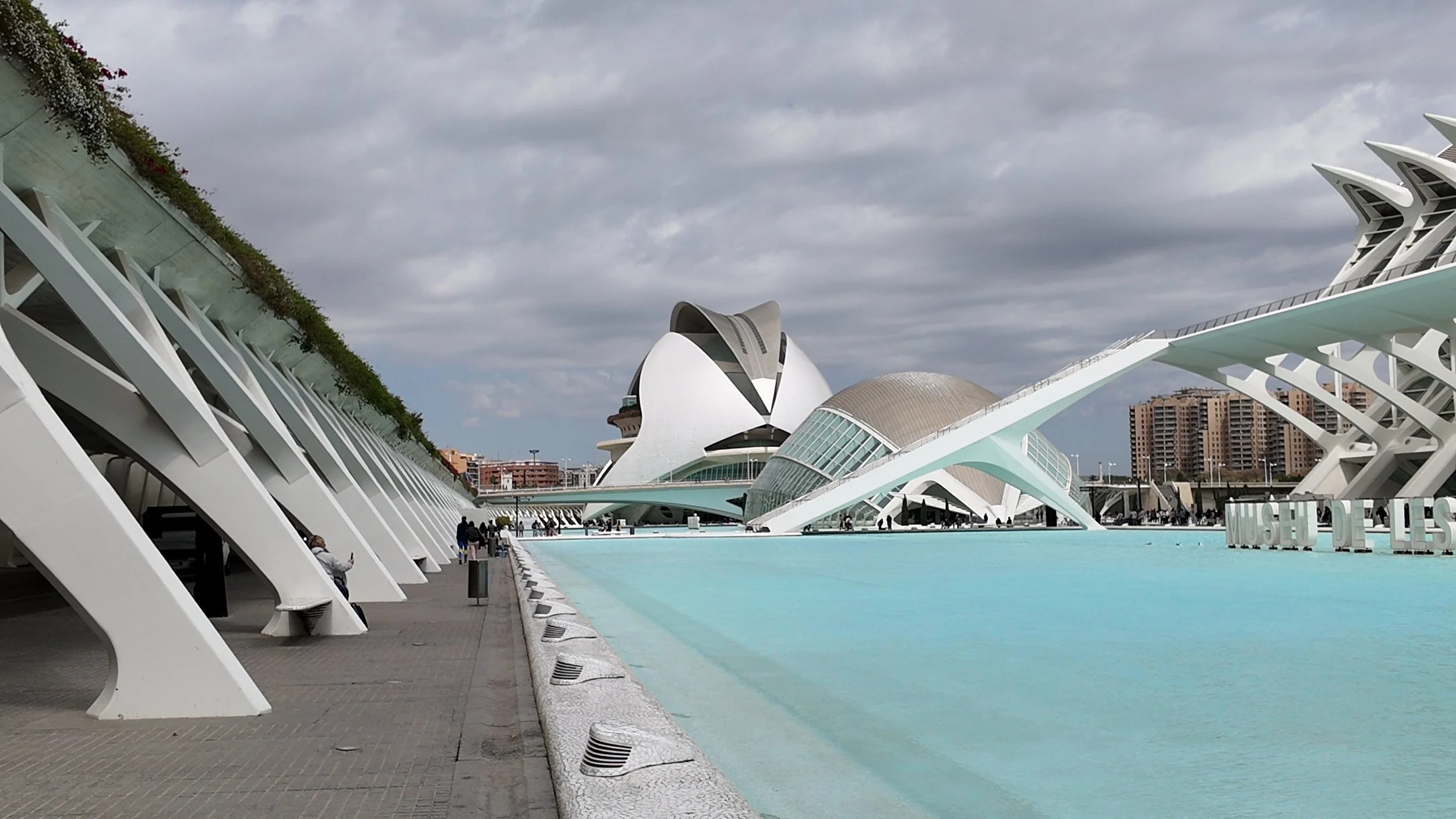
It’s a futuristic whale-shaped complex on the Turia River with several attractions. It includes:
An IMAX cinema and planetarium
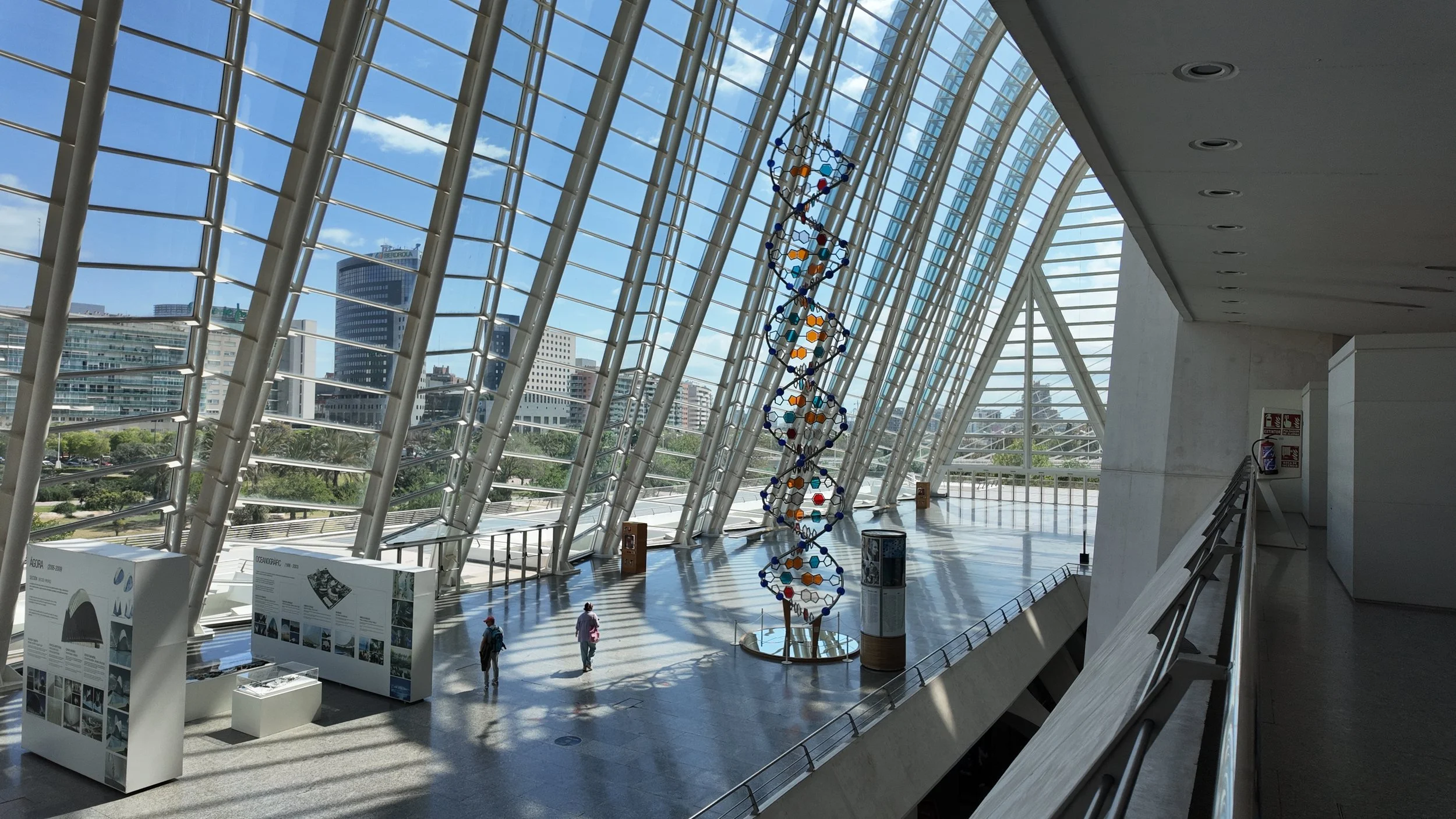
Prince Felipe’s Museum of Science. It's your classic science museum, except that the whole first floor is a basketball court
A biosphere known as L’Umbracle
The Oceanografico aquarium
An opera house
Even if you didn’t go into any of the attractions, the bridges and courtyards around the complex are fun. Though if you made it that close, it’d be odd not to go in.
Each museum within the complex could merit a whole day’s activities. We prioritized the science museum and the aquarium for our two-day pass.
Any guesses about my kids’ favorite part?
It was the café in the lobby of the Science Museum where robot cats serve as the waiters.
Sharing a city with the mother of all science museums must be pretty tough on other exhibits around town. But there’s a huge upside! Much smaller crowds.
Valencia’s Museum of Prehistoric History is information-rich. It's also full of interactive things for kids to get their hands on. It’s also built into an old Byzantine style church, so the structure itself is of interest. You’ll want to budget a good amount of time for this one.
L’Iber – You’ll remember this one as “the toy soldier museum.” It's a massive collection of tin soldiers and other miniatures. It can capture attention and imagination for much longer than you’d expect. It feels like you’re looking at every war Spain ever fought all at once.
L’Ento – The Valencian Museum of Ethnology, but think of it more as Valencia’s pop culture museum. Grown-ups might note how art and entertainment reflect its history and politics. Kids will find several displays featuring toys and cartoons, and other familiar things.
And while this isn’t a formal museum, I gotta shout out the Casa de los Gatos. I have a little girl who loves cats. Kids who share that fondness will love the tiny decorated facades. These decorate openings in city walls that house street cats.
To me, this was the most obvious reason to visit Valencia–or at least somewhere in Spain–with young kids. Nap time is still an important part of the day. Why not head to the country that seems to have perfected the art of napping?
That said, there is a flip-side to putting your family on the Spanish schedule. While the naps are decadent, prepare for the days to stretch out longer. Dinners often kick in around 8:00 pm or later. Don’t be surprised if bedtime gets rolled back a few hours.
At home, staying on schedule seems to serve us well. But when in Spain…

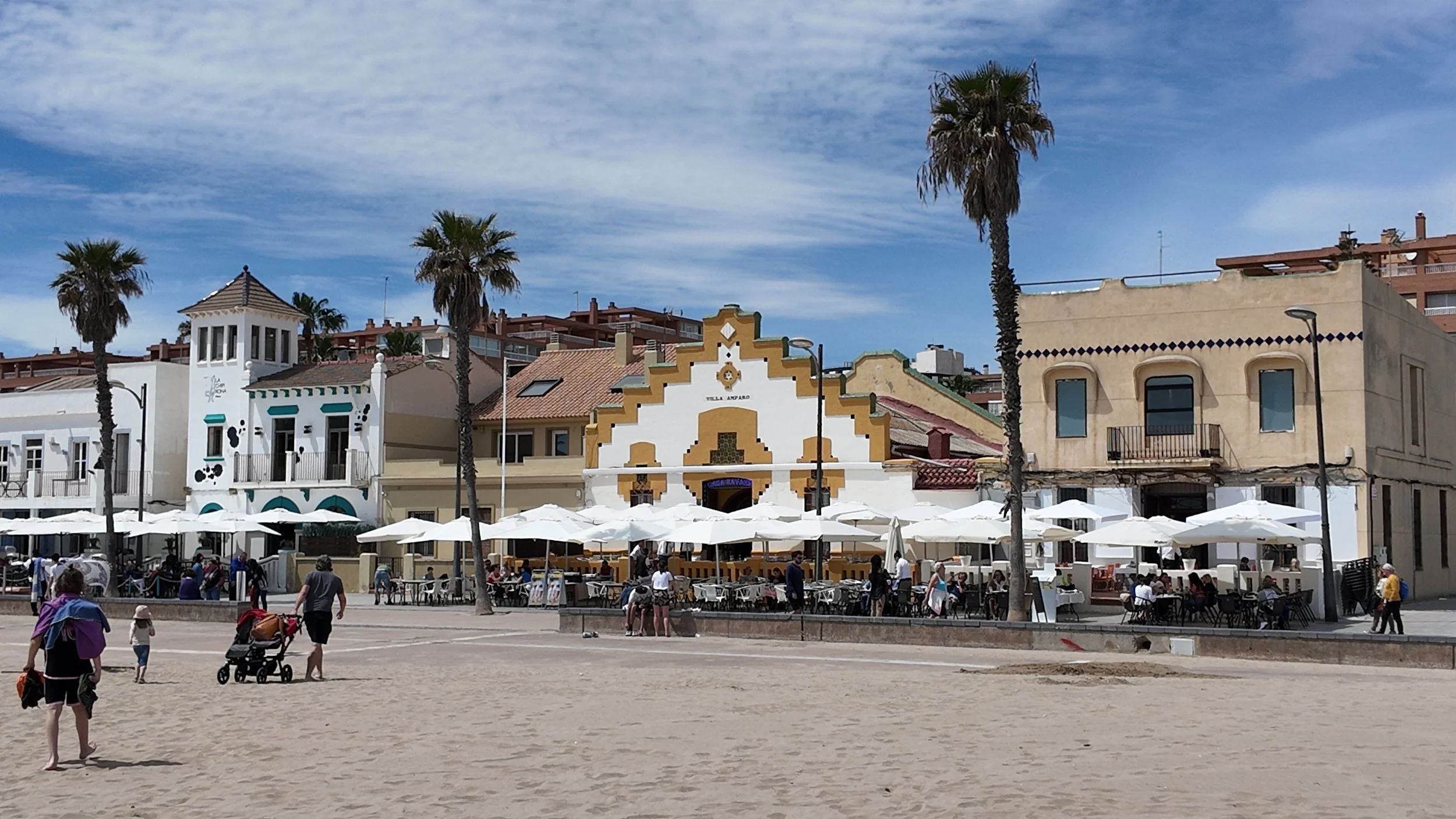
We stayed in the Malvarossa neighborhood of Valencia. That meant that we were always a mere blocks away from the beach… and we took full advantage.
It surprised me that every single day, Malvarossa Beach seemed quite empty. We seemed to have several soccer pitches worth of open sand and water all to ourselves. The sand was smooth and perfect for building things. The Mediterranean waters were the perfect temperature.
We were there in April. Maybe that helped keep the beaches empty. They seemed capable of accommodating much larger crowds.
Every 200 meters was another unique play structure. The parallel sidewalk was lined with cafés.
In the mornings, this strip of beach worked well for a 10k run.
It is most likely a lot more packed in summer.
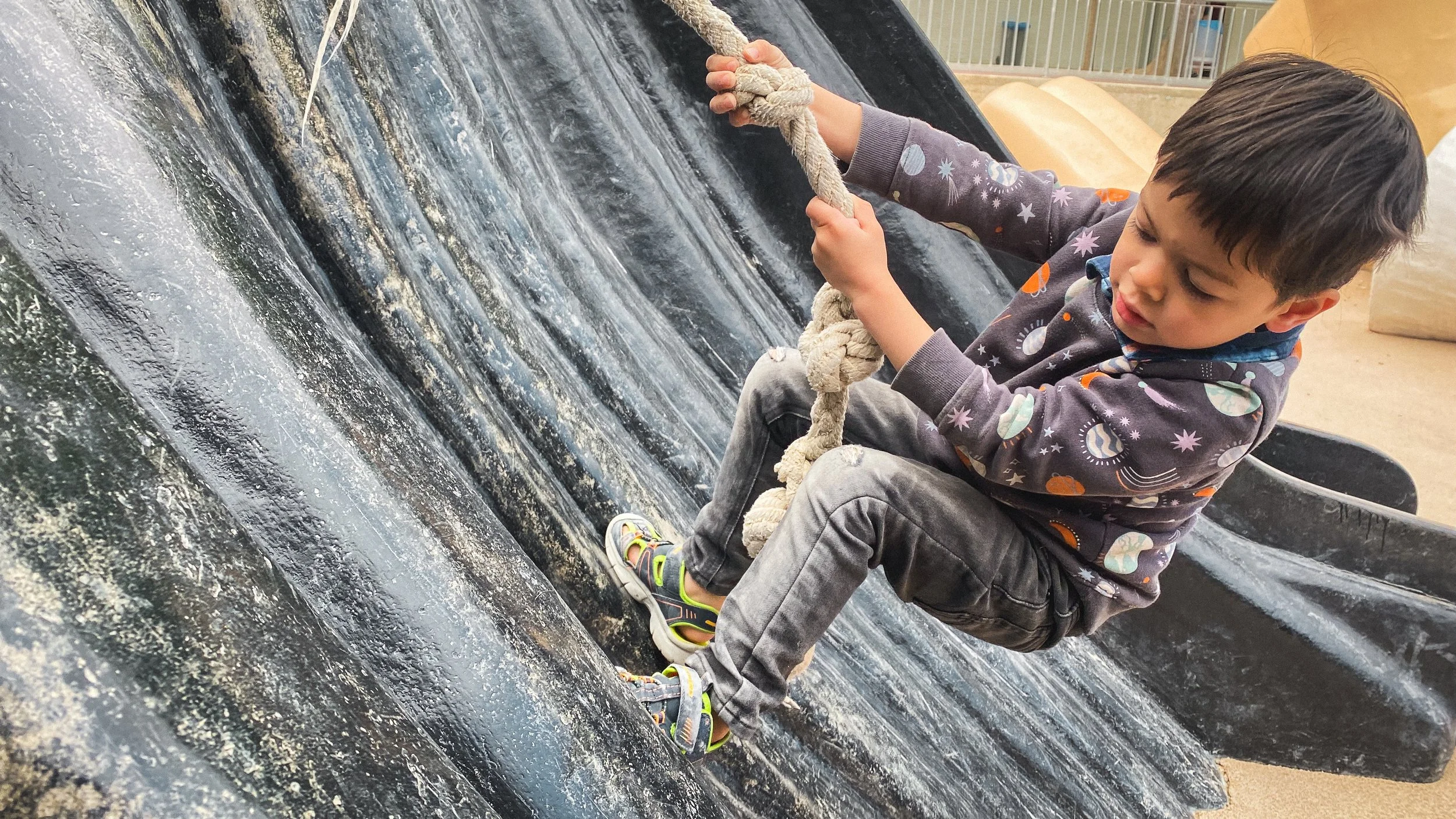
On the beach, you couldn’t go very far without running into a playground, and you know what? That was basically true for Valencia across the board. There are play structures everywhere.
Some playgrounds are in more central parks and plazas. These typically had more complex structures and lots of families hanging out. But even in low key walkways, it seemed like the City of Valencia figured out a way to squeeze in a slide and a jungle gym. There was one right outside the supermarket which made shopping a lot easier.
One observation of these Valencian playgrounds: there is no shortage of rocking horses. Or rocking motorcycles or dolphins. Whatever designed seat they decided to put on a giant spring.
At some point I imagine a Valencian city planner got it deep in his head that them kids love rocking horses!

Parque Guilliver, that is!
It’s a large structure of tunnels, staircases, climbing walls, and slides... all in the shape of Lemuel Guilliver. You know, the sailor stranded on Lilliput who is then tied up and climbed all over by the tiny Lilliputians.
Gulliver’s Playground is only one part of the Jardin del Turia. Turia is largest urban park in Valencia and a place you can visit over and over for family walks and other outings. It was built into the old riverbed of the Turia. Back in the day, it flooded, making the city rebuild. Now it also features a model train, Centro Ferroviario Camp de Turia, that the kids can hop on.
But are kids these days even up on their Gulliver lore? Seems like a forgotten fandom to me. Have they no idea who they’re climbing on?
Probably not. Even that Jack Black movie adaptation was 15 years ago. He’s the Minecraft guy now.
Nonetheless, the playground is doing its part. And it’s still fun. And some of those slides are actually pretty intense, so keep an eye out if you have very small ones.

Here are a few of my picks:
Xativa – A medieval city on a hill with stone walls and ancient castles. If you’ve got castle-fixated kids, this is ideal as long as they can handle the walking. Lots of little shops and cafés.
Ruzafa – This isn’t even a daytrip where you’d leave Valencia. But Ruzafa is Valencia’s bohemian hipster suburb. Lots of vintage shops, used bookstores, and tapas joints.
Albufera Natural Park – This nature park is set on the Southern Spanish Wetlands. There are boat rides and plenty of wooden walkways to explore. It’s a great escape to take a break from the city.

The historic center of Valencia is actually a good spot to get lost for a little while. Large parts of it are pretty pedestrian friendly. It’s easy to grab some essential Spanish eats while walking around. Here's what's worth seeing.
Plaza de la Reina – is the iconic central plaza. Sometimes I enjoy just embedding myself where all the action is and taking it all in. This is that kind of place.
On the northern end of what I’d consider Central Valencia is Torres de Serranos. Those Gothic towers once served as the city gates. It matches my childhood impression of what a castle should look like. Two rooks from a chessboard connected by a wall.
One other very Valencian thing I wish we had the chance to do was to catch a Valencia CF match at Estadio Mestalla. My favorite La Liga squad is the one untethered from Barcelona and Madrid. While the schedule didn’t work out in our favor, we did get to bop around the fan shop in central Valencia for a bit.
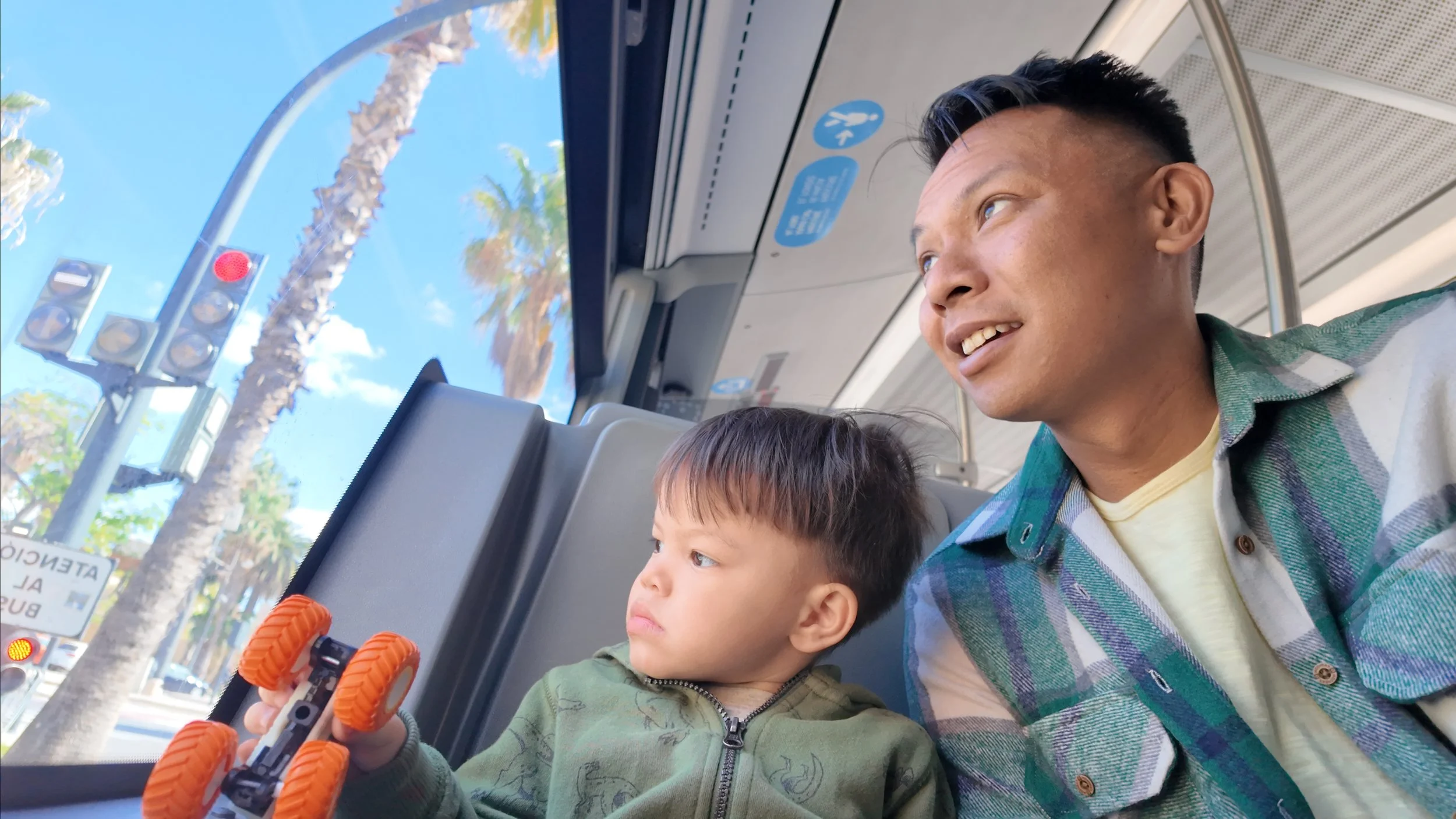
I have a transportation kid. As in, a young boy obsessed with vehicles and ways of getting around. Trains, buses, all that. And the public bus system of Valencia was his idea of a good time.
Valencia's buses made it easy for us to get around. Our main routes went between Malvarossa and the City Center. The bus route enabled us to discover lots of restaurants and cafés, along with a look at ordinary Valencian life.
It’s also worth noting that Valencia is an excellent bike town. If my kids were riding bikes already , we would’ve borrowed some wheels. Rent Bike Virgen is a great spot to hire a bike to pedal around Turia Gardens and other spots.

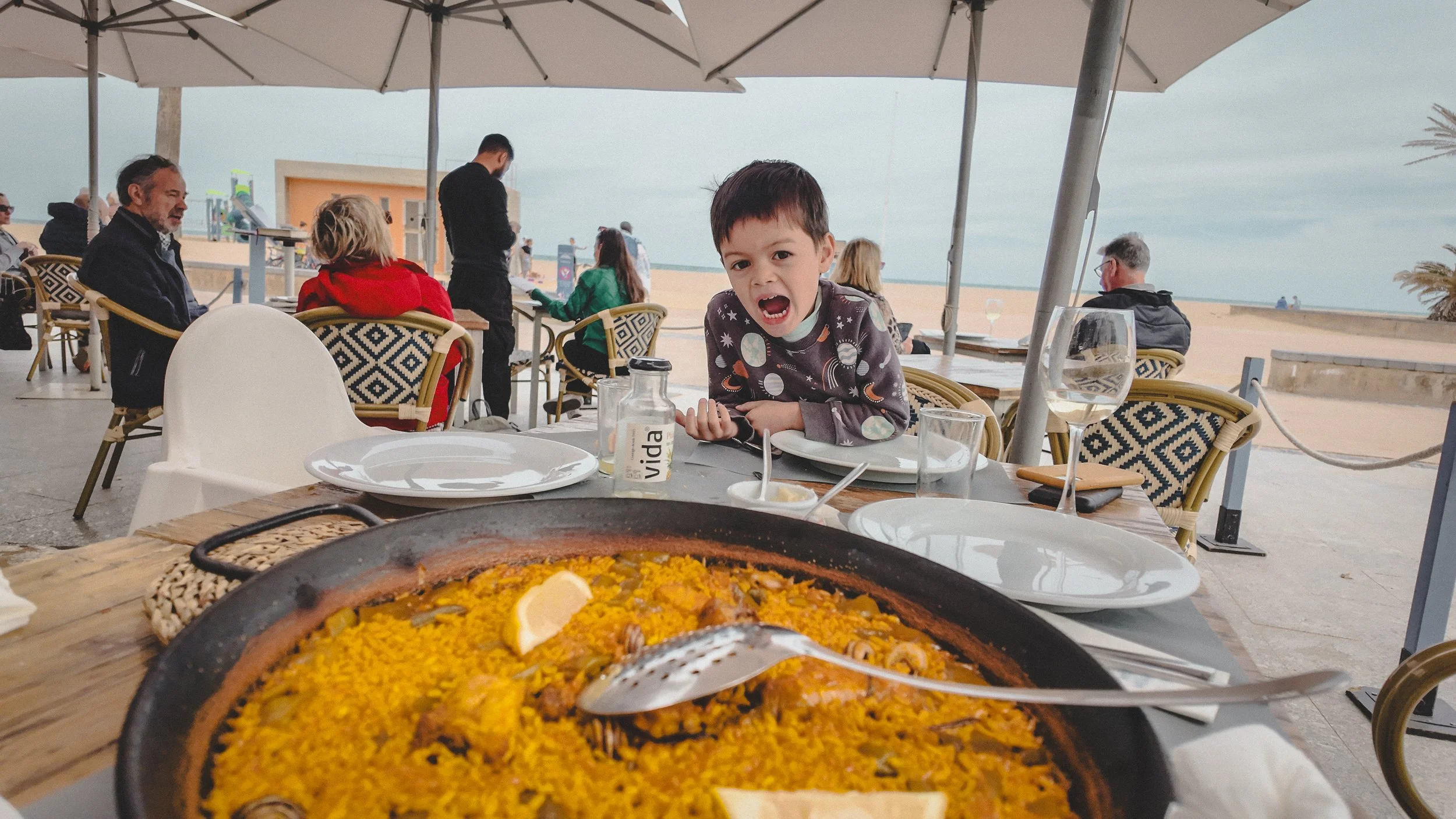
We decided to not serve meat to our kids until they could understand where it comes from. Spain made that so much easier with the hanging pig legs at every grocer for jamon iberico. One of our kids had his first animal protein on the trip. Not ham, mind you, but escargot. A snail picked right out of a pan of paella.
The must-try items are well-known. Jamon iberico. Wine. Paella. Oh, and note that paella with seafood is generally seen as a tourist play. The local stuff will have chicken, or more likely, rabbit.
I do recommend the Mercat Colon as a food hall where you can try a good number of things. Valencia happens to be the origin site for horchata. One of my favorite spots to grab one would be Orxata Daniel, located within Mercat Colon. To top it all off, I’d visit a rival horchata-maker, L’Orxateria… but for their churros y chocolate.
Once again, I am so glad we made Valencia a destination. Even during these years of challenging young-kid travel. There are a few other considerations I’d keep in mind:
Timing – We did very well by visiting in April. This was possible, of course, because our kids aren’t in school. Missing three weeks in the spring is easier in preschool than the higher grades. Our reward were those wide open beaches, as well as temperatures. Spain gets hot in the summer, to the point where I wouldn't recommend it anymore.
Las Fallas – It’s Valencia’s most popular carnival, and it’s definitely a memorable thing to experience. The drawback is that unless you stuck around for a lot longer, you might not experience much else. Expect way longer lines at the museums and higher prices for everything.
Ever do Valencia? With kids? Thinking about it? Let me know below!

Aotearoa dreaming.
Very unsurprised by how much I loved this New Zealand. Sharing some more favorites.


Kitekite Falls – The waterfall was gorgeous, and the pool below made for a great swim hole. But also, don’t overlook the walk up there. Wonderful nature walk with some fascinating vegetation.

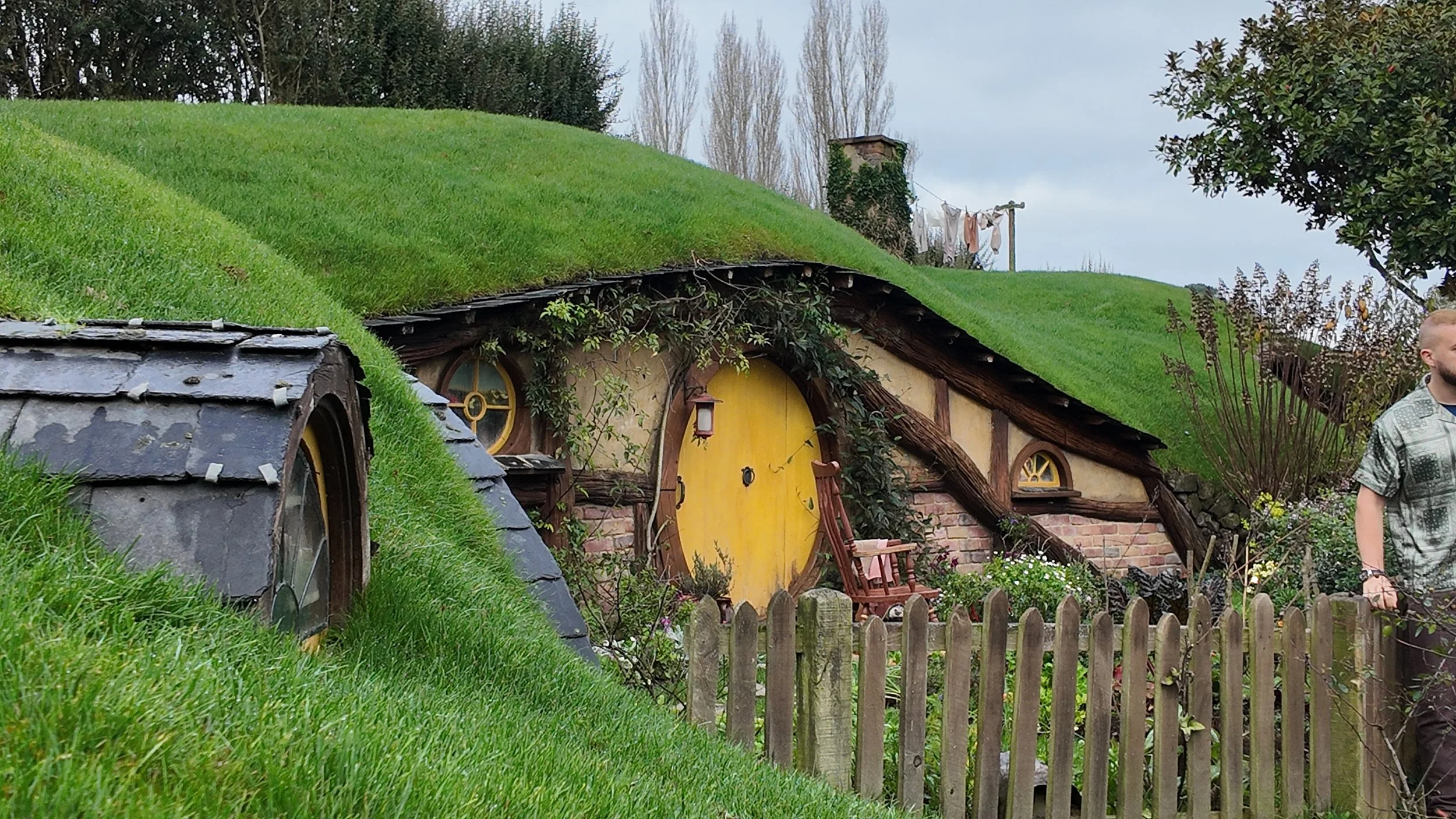
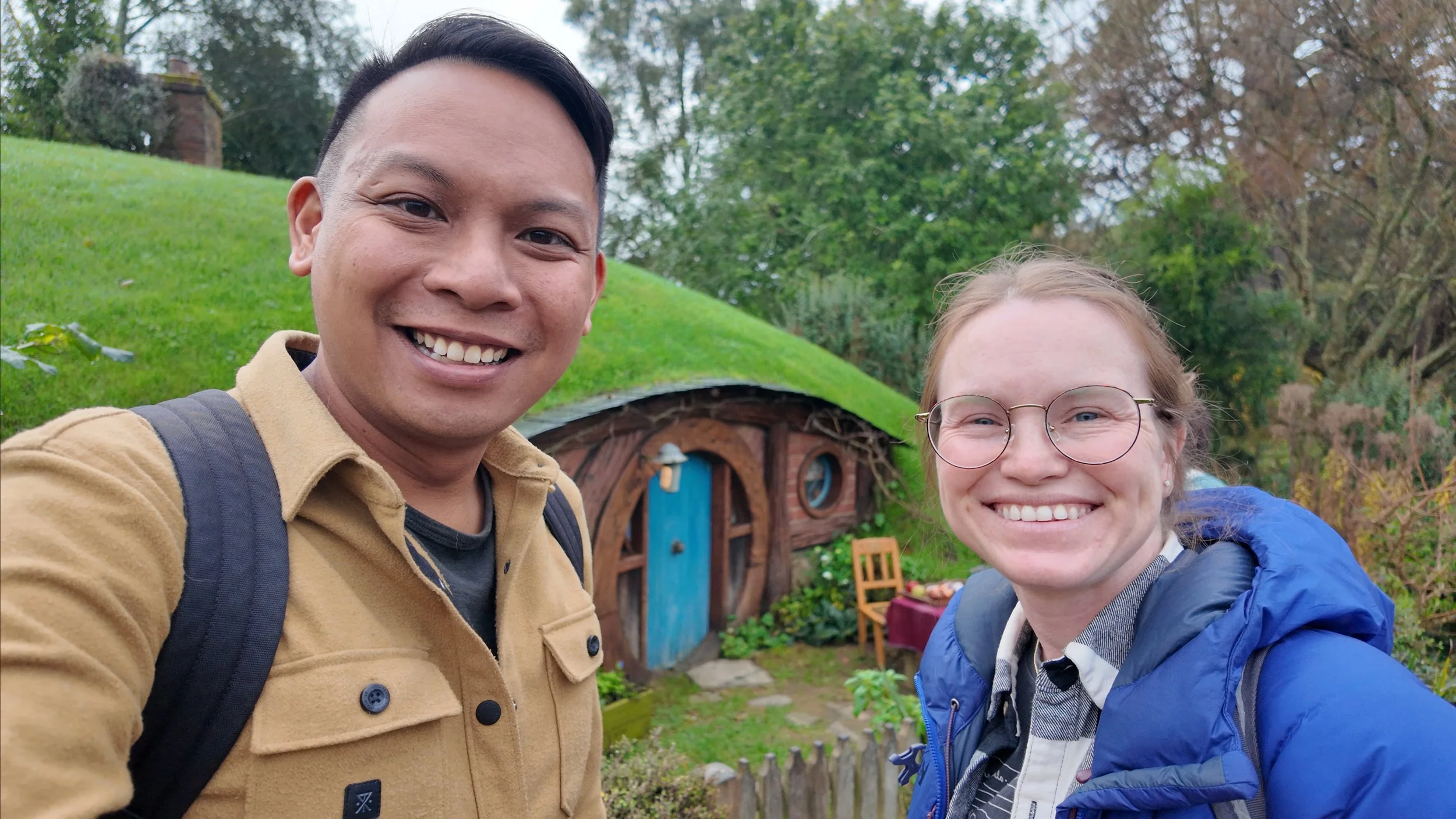
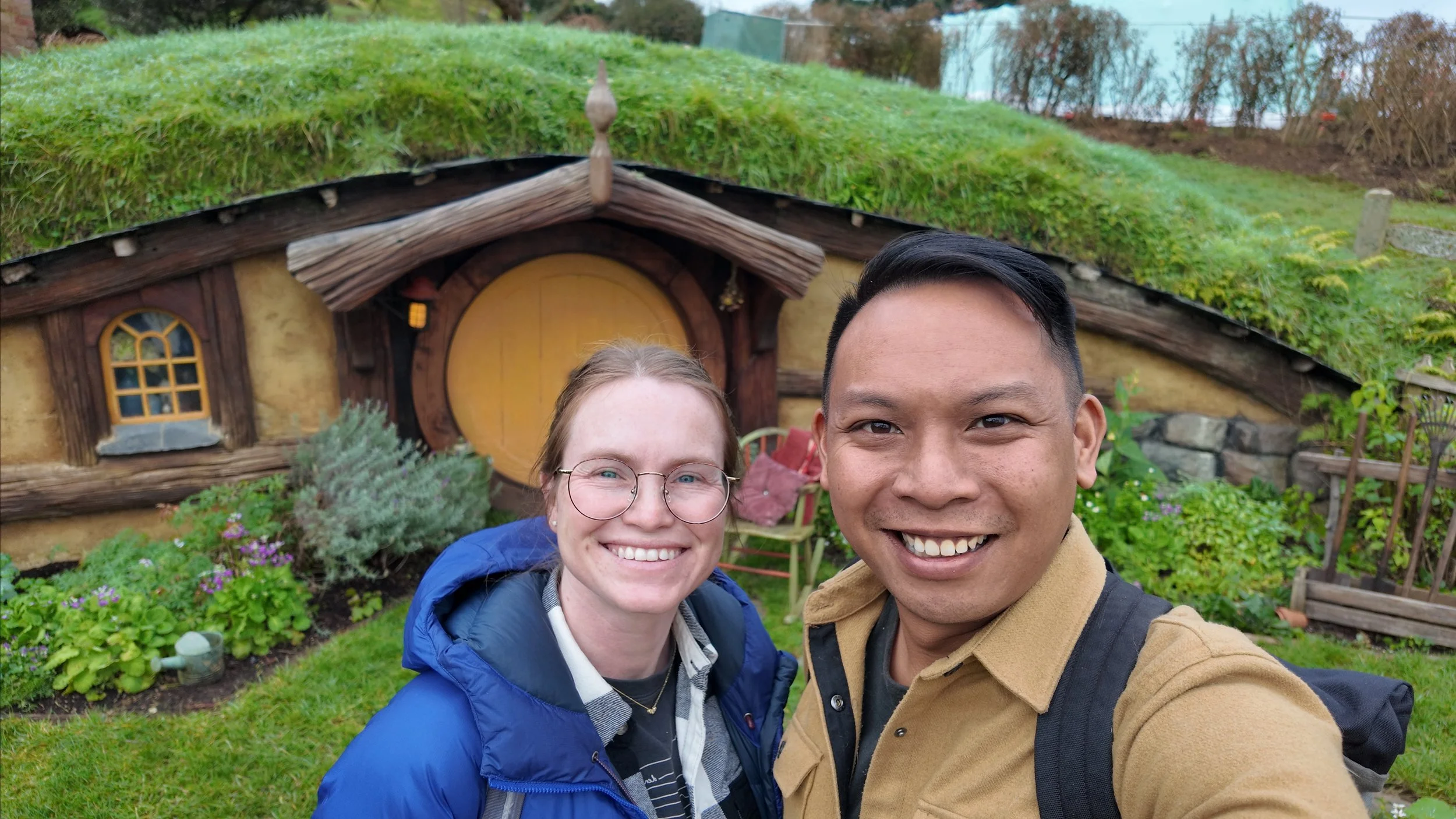
The Shire – Probably the most touristy thing one could do in New Zealand, but still pretty chill. Loved walking through a hobbit house.


Green Dragon Tavern – They’ve got their own exclusive ales, so hopefully you don’t like it TOO much. You won’t find it elsewhere.
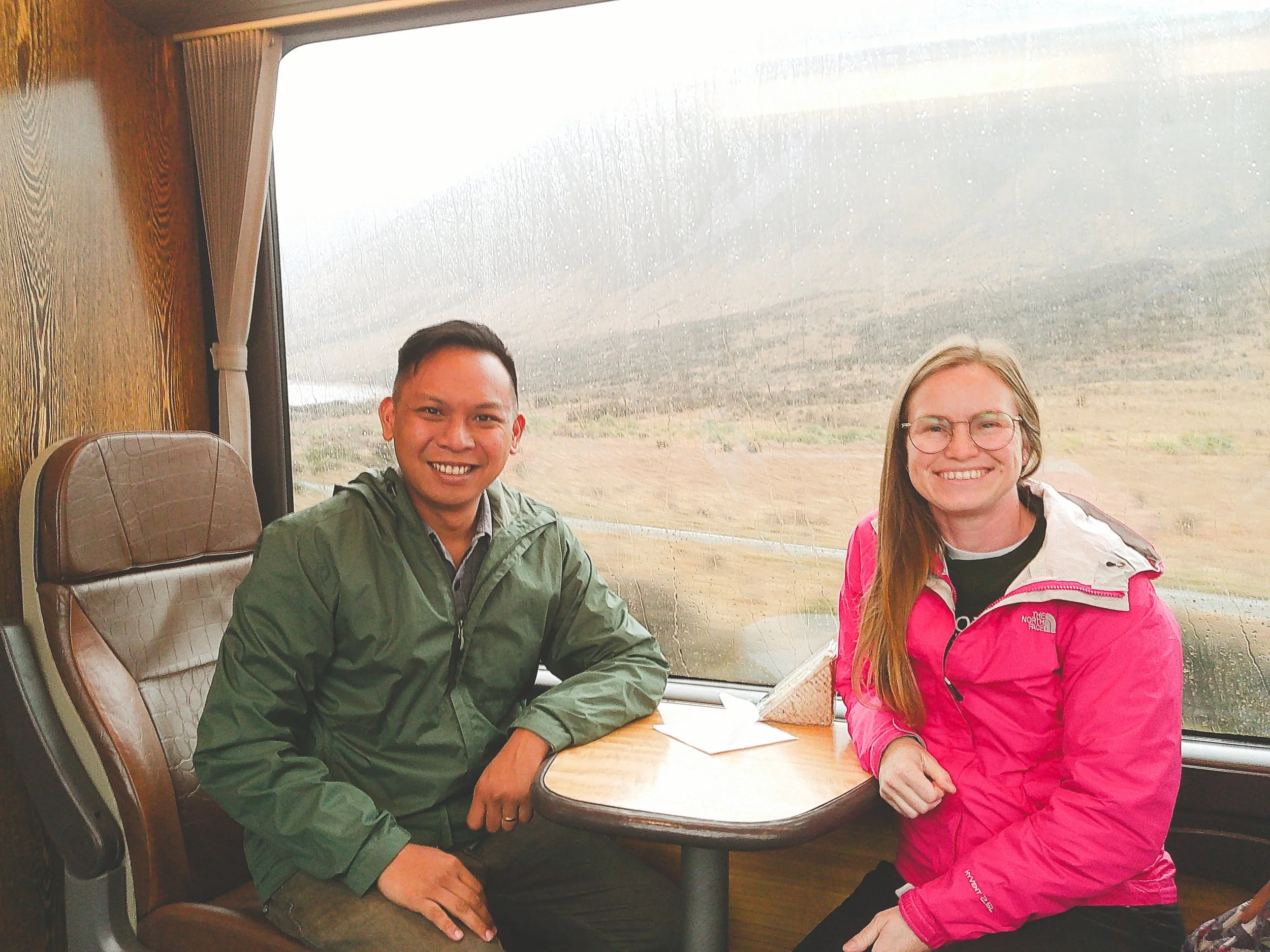
The TraNZalpine Rail – Scenic train ride up to Arthur’s Pass, with an onboard café and a viewing cart.
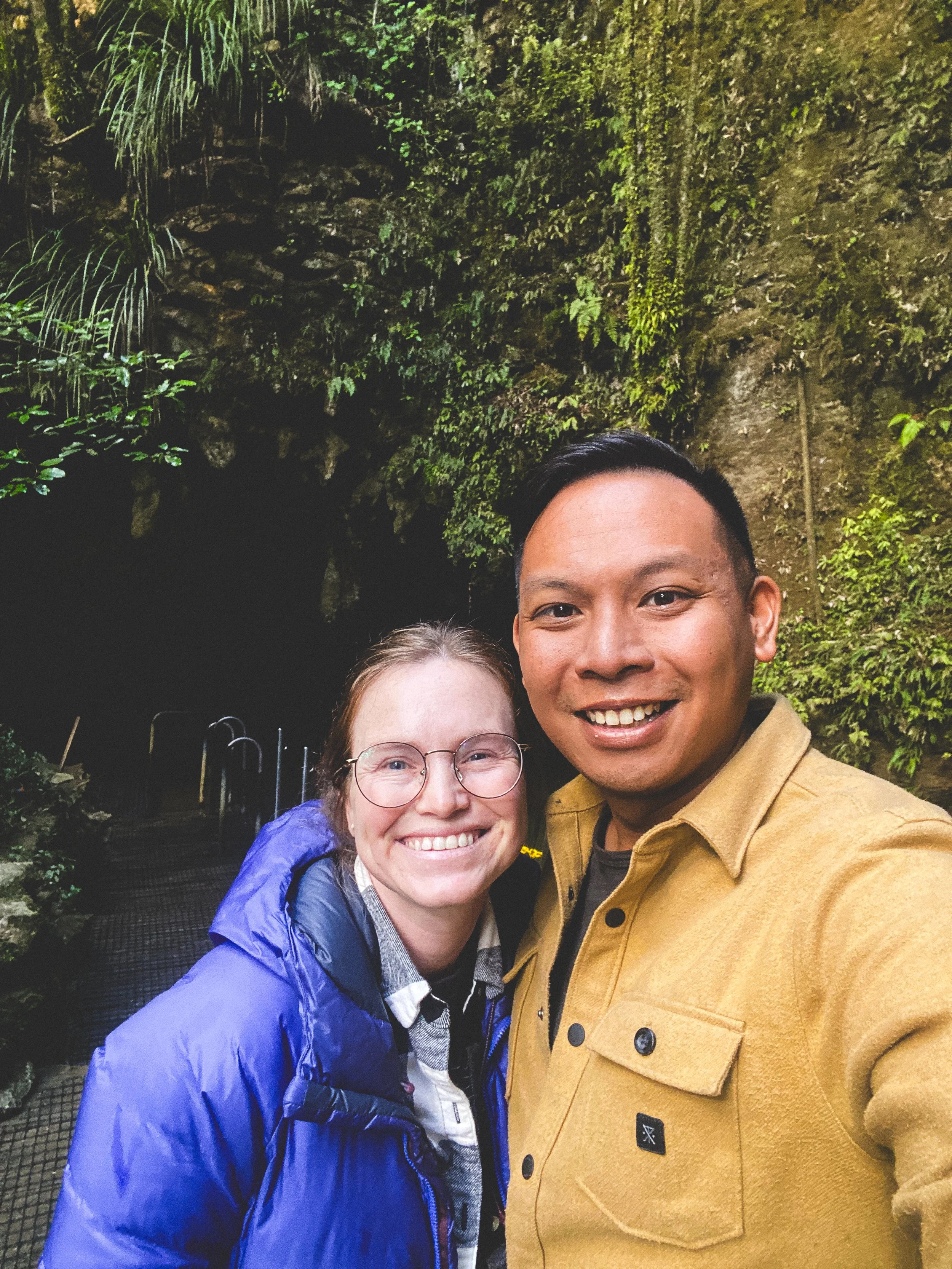
The Waitomo Glow Worm Caves – My favorite single outing in New Zealand. Absolutely breathtaking moment of wonder.


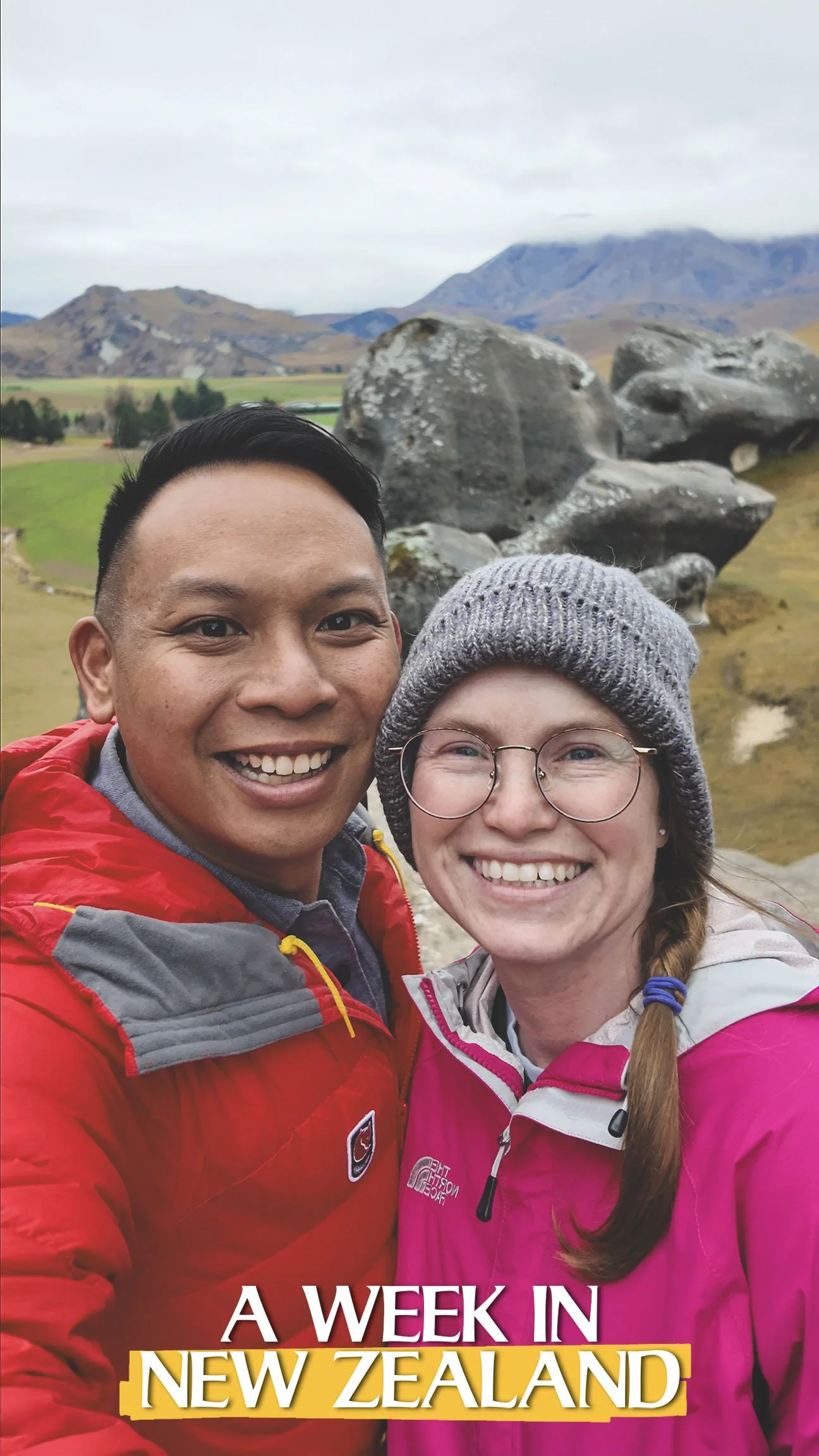
Castle Rock – Famous for being a film site in the Narnia movie, but even if it wasn’t these boulders are impressive
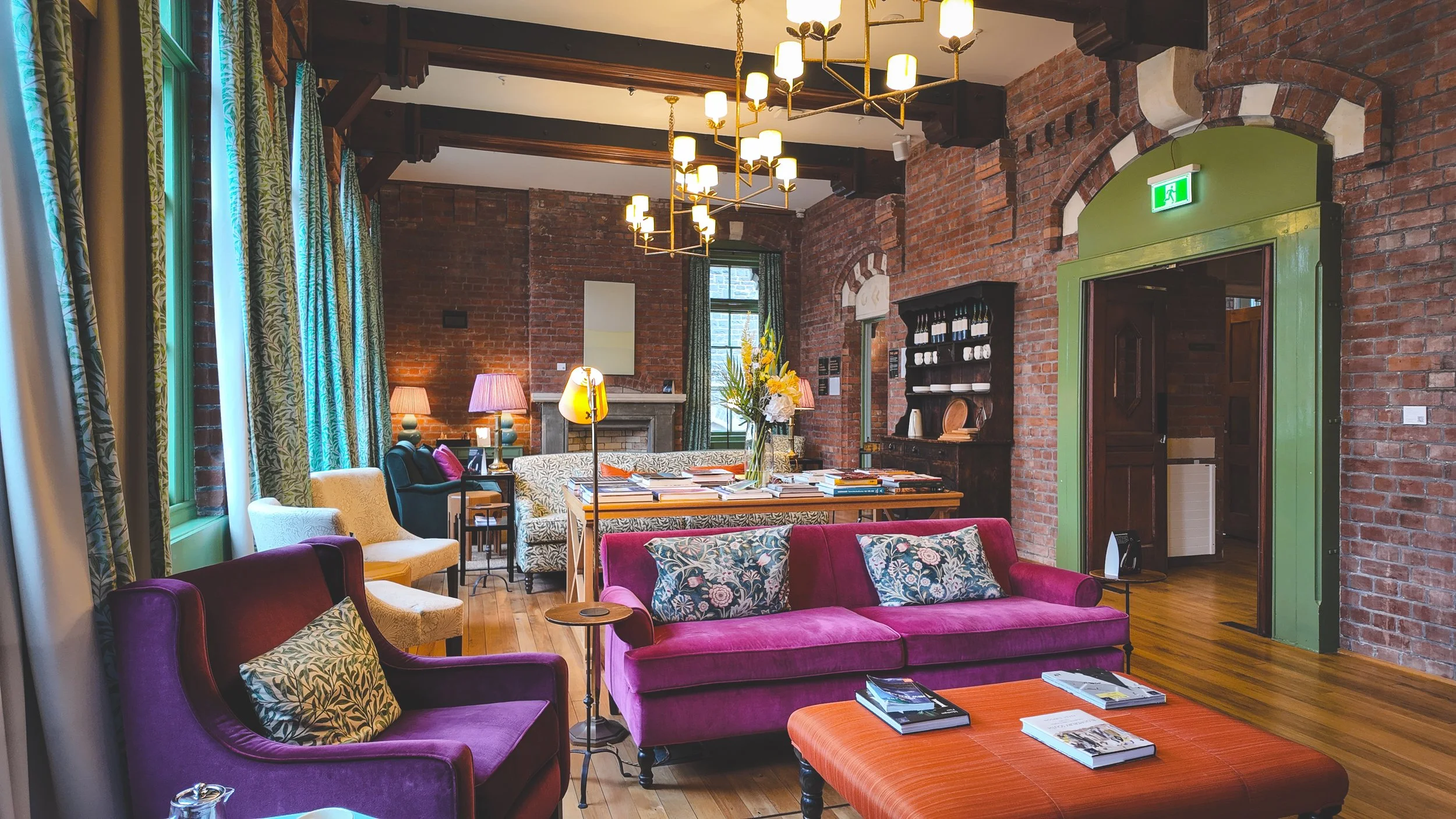
The Observatory Hotel – Maybe my favorite hotel? The drawing room alone was worth it.
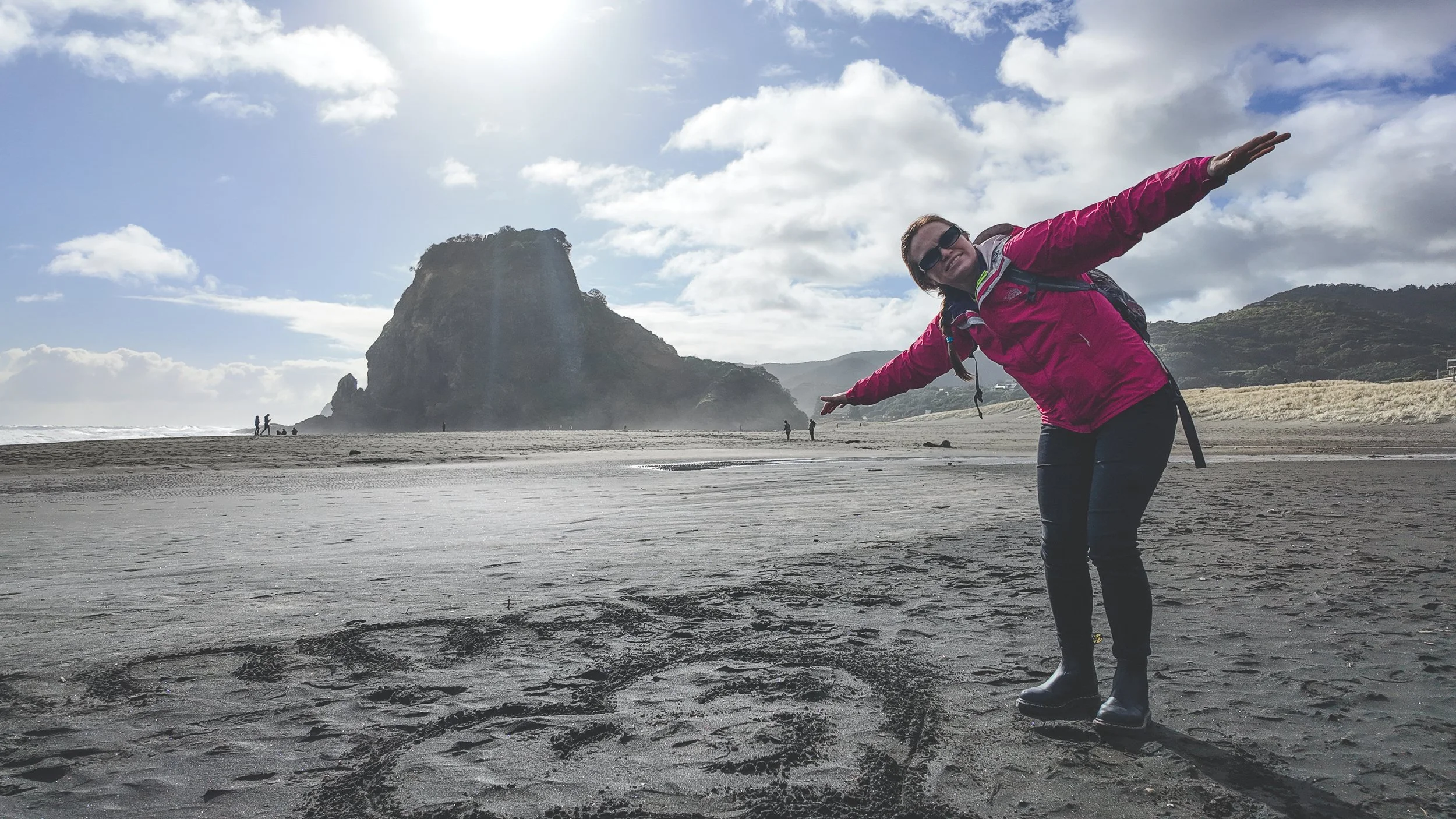
Piha Beach – Intense waves, but a unique mix of beach and forest

Devonport – Daytrip by ferry

“Imagine, you could have all this”
I knew there was a deeper reason mezcal was always my favorite
In about 10 months, my twins will graduate from daycare.
This will free up a significant chunk of change from the family budget. For five years now, a large chunk of my paycheck has gone to a little daycare center down the freeway.
Now there’s a light at the end of the tunnel.

It’ll be tempting to redirect those funds to a vacation, a bigger grocery budget, or a series of little treats. and throwback soccer jerseys, there’s a very grown up and responsible thing to do with it.
Putting it in an education savings fund for the next time we may be staring at three tuitions at once: college.
I always imagined that by the time my kids were college age, things would be different. Brand new norms around higher education.
In what way?
Haven’t got a clue.
I’ve been saving money to support them in college... OR whatever the alternative plan is to launch their independent lives.
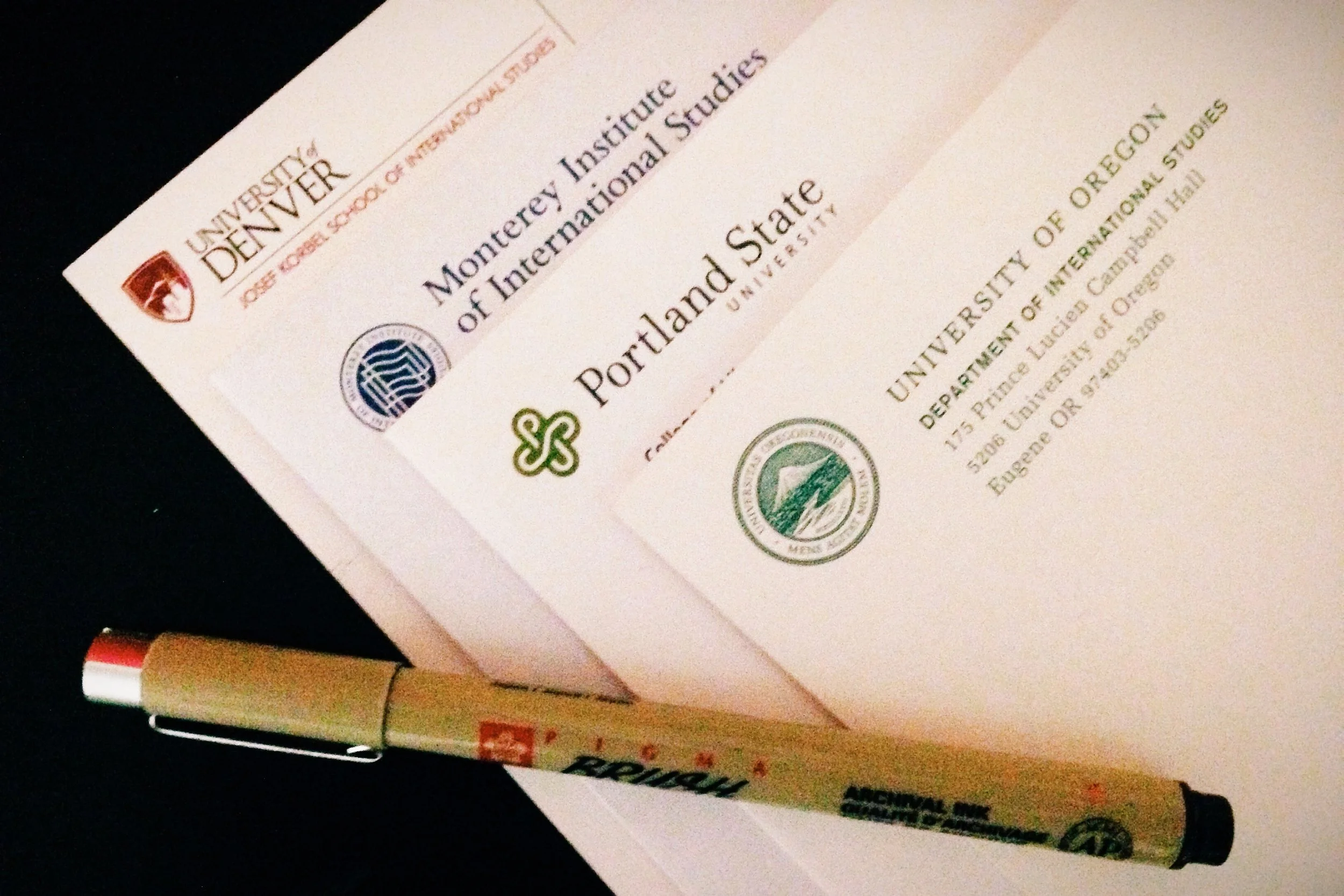
About 20 years ago, I paid a $16,000 tuition for UC Santa Barbara.
I can imagine how much those price tags have increased.
How much tighter the competition has gotten for those enrollment slots.
All while more and more people question the value of the degrees.
And it’s hard to blame them.
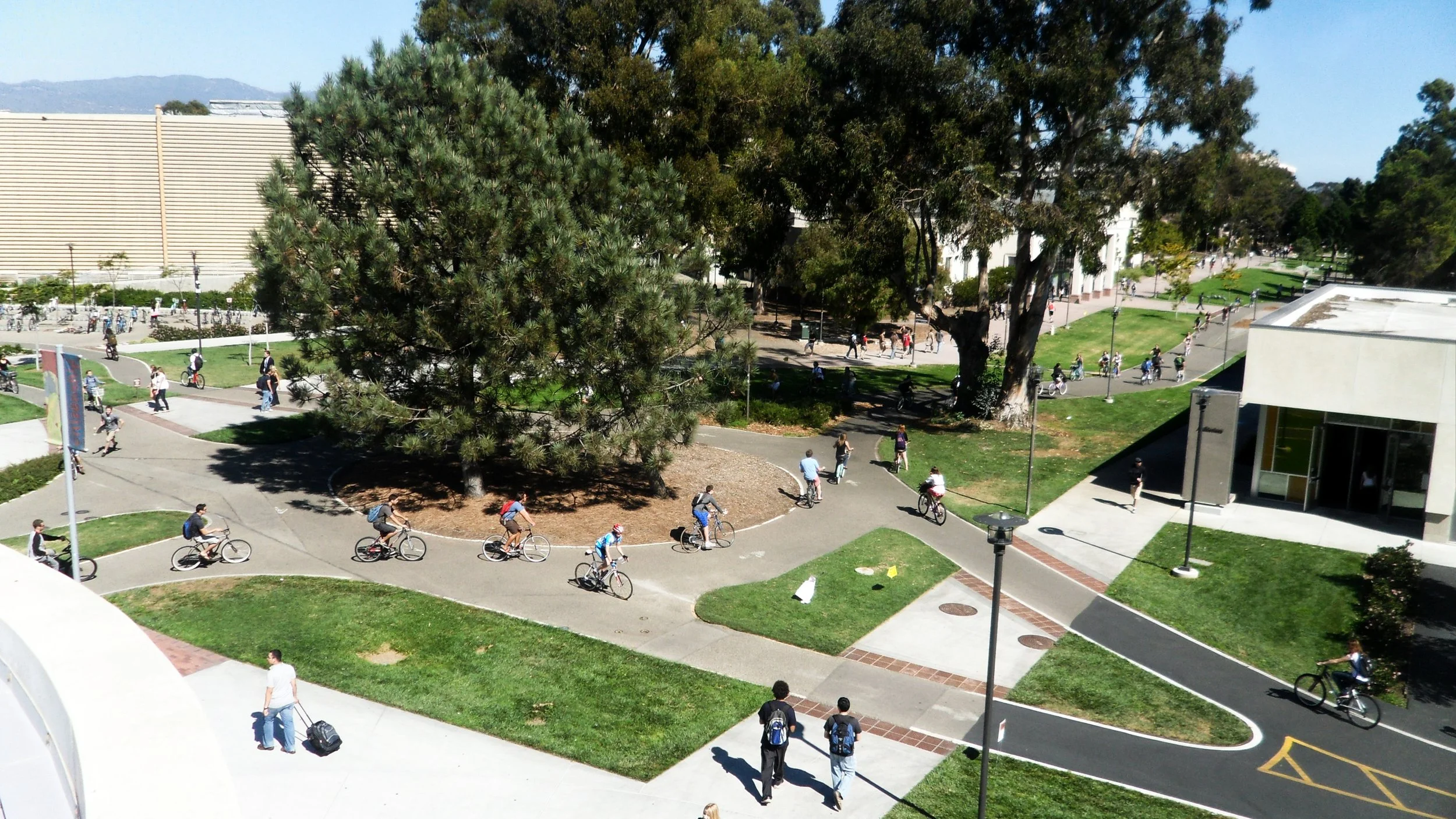
I grew up thinking of college as something that would get me better jobs, higher pay, and a better life.
The presentation seemed clear at the time. But looking back decades later, it feels like an overpromise-and-underdeliver.
It’s very common to find struggling MAs and PhDs and seven figure dropouts. I’ve also found it common to find high-earning dropouts who believe everyone should do it their way. College is a scam, isn’t it?
Many embrace a middle path of doing two years at a local community college. Later you can finish at a larger university for the same degree. I applaud the creativity and the reach beyond black and white thinking.
Still, my college years were some of my most fun. It would feel like a big shame to have to chop them in half. But the ratio of practicality-to-price tag may be tipping the scales on this one.
At this point I still have well over a decade before my kids cross this bridge. By then, the system and its norms will have evolved a few more times.
But there are some things I want those kids to consider.
Your uncle might scoff at degrees like philosophy or English. What are ya gonna do? Speak in English even more? Be a stand-up philosophizer like Mel Brooks? And to be fair, colleges don’t do themselves a favor when they promote classes that seem unserious. The very first lecture I ever sat in was a seminar on Japanese Horror Movies. (Man they make ‘em creepy!)
But there is value to having knowledge that isn’t only utilitarian. Society as a whole benefits when you have electricians who can appreciate literature. When museum curators can crunch data.
And every field is a little bit different.
For what it’s worth, I absolutely love my career. I managing communications for an international nonprofit to solve global environmental problems. My degrees? Communication, international studies, and nonprofit management.
When I was being hired for the position, I don’t doubt that this background helped me stand out in a crowded field.
I have no clue what college will look like for my kids in a decade. But there are two big ideas I hope they keep in mind.
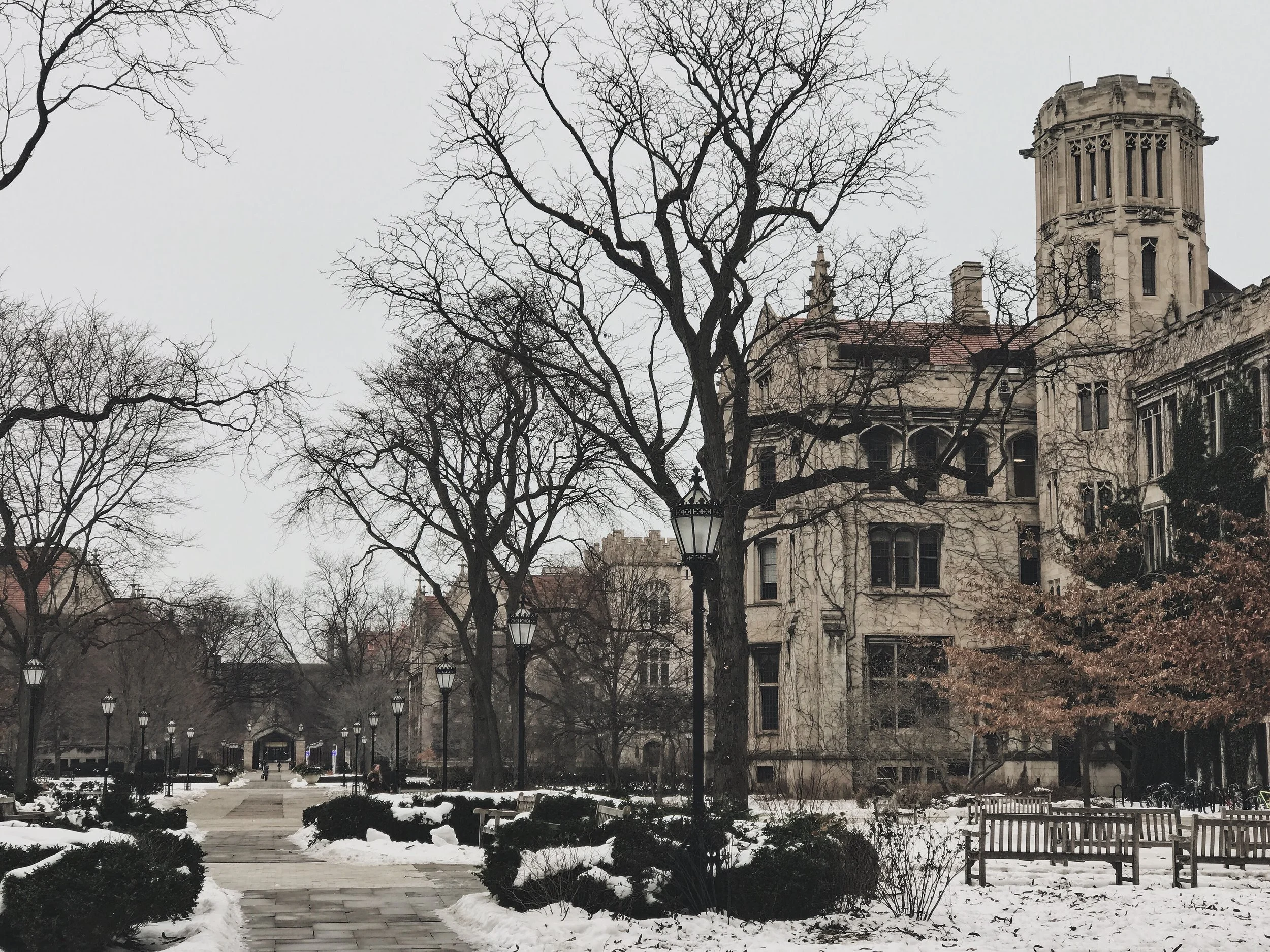
I think a lot of the best learning I did during my college years happened outside of the classes.
Don’t get me wrong. I’m thankful to know what I know from lectures on Franz Fanon. Happy to know about Hinduism. The Sykes-Picot line. Descartes. Purchasing Power Parity and Japanese horror films. But I don’t think they hold a candle to what I learned outside of classes.
Signing up for a TON of extracurricular activities right off the bat taught me how to budget my time.
Living in with roommates taught me how to be a responsible adult and not a jerk.
Dating taught me about mature relationships and respect.
Studying abroad taught me that travel is one of my favorite things in life.
Late night conversations with friends taught me a lot about God, people, and the world. Especially when those friends had way different backgrounds.
And yes, you don’t have to enroll in anything to have these learning opportunities, but…
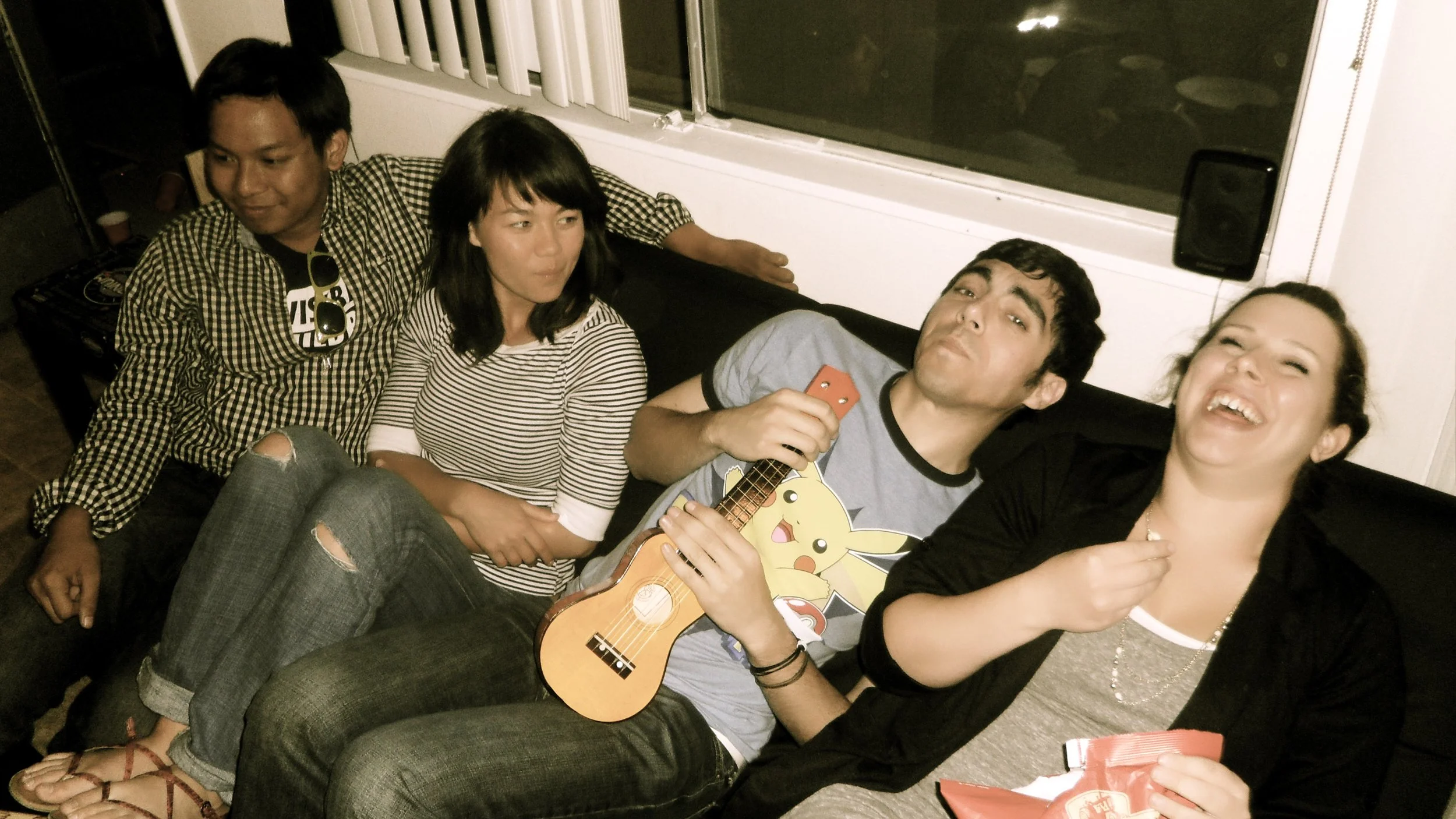
College life is a unique concentration of people around your same age that you’re doing this with.
Those connections alone are worth the cost, in my eyes. Oftentimes those connections do lead to your career. That said, I don’t want to commodify relationships. They’re great for their own sake!
Sure, maybe I’m biased. I did meet my wife in college, after all.
In college you likely live within a walking distance of your daily routine. Your community. You can walk outside, bump into somebody, and decide to study or party or whatever.
Even if college classes and degrees aren’t on your path, the environment still has a lot to offer. You can often still sign up for clubs and student groups. You can still make connections there.
Sometimes I hear people talk about school like they expect to be given knowledge. Spoonfed. Then hired.
I don’t think we should approach life this way, as passive recipients of what comes our way.
Learning is a dynamic process. We take stock of the pieces around us. We figure out how they might fit together, consider their stories, then try to make something out of them.
And maybe we have some good parties along the way.
“The circumstances of one's birth are irrelevant. It is what you do with the gift of life that determines who you are."
–Mewtwo
I used to want to be a war correspondent doing badass frontline things. But now, I’m pretty thankful that I’m sort of the opposite of that.
I get to tell stories of peacemakers and community builders. People who spend themselves in service of those who are hurting. People who move solutions forward. People whose practices turn into culture.
What a gift.

“We must learn from each other and share the wisdom from each culture"
–Whina Cooper
There’s a strong relationship between the social unraveling of the past decade and the disappearance of funny movies.
Think about it for a second. When did the world start to become as divided, hostile, and on-edge?
Okay… that’s a pretty loaded question.
Was it the pandemic? The rise of authoritarian movements around the world? 2016? Did the Cubs winning that World Series actually open up some portal to some dark timeline?
There’s a decent percentage of people out there who would probably respond with: what are you talking about? Things have never been better!
And if that’s you, well we probably don’t agree on much. Thanks for reading, but we’ll probably have a tough time connecting over my writing.
Another chunk of people would respond with: things have always been pretty bad for a lot of us. Privilege just has you distracted!
And if that’s you… you’re not wrong.
But still, there’s been something about these past few years that’s just… let me put it this way:
Every now and then this clip goes around from the 2012 presidential debates. One of them took place during Mitt Romney’s anniversary, and Barack Obama teases him about having to spend his anniversary with the president. It was lighthearted and a longshot from anything you expect to see on that stage any time soon.
So something’s shifted since 2012.
That shift just so happens to line up with another shift that’s taken place over the same timeframe… the fact that comedies don’t really get produced anymore.
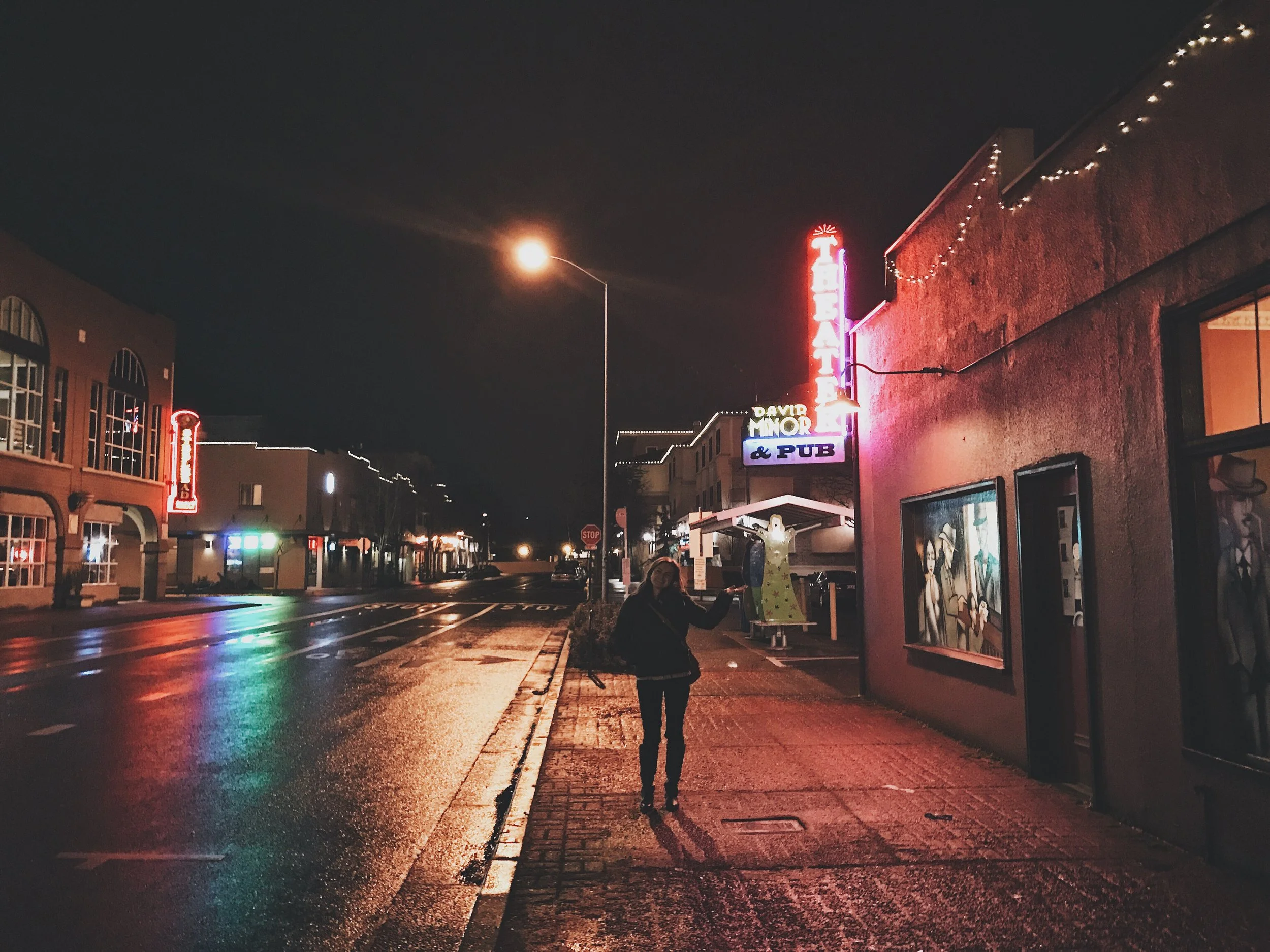
The Y2K era rom-coms like Miss Congeniality and Meet the Parents were making way for Will Ferrell’s monster run of character-driven classics. That gave way to the crude but weirdly sweet Judd Apatow entries of Knocked Up, Superbad, and so on.
It’s hard to pinpoint exactly when these started to fade. But as the 2010s progressed, the laughs slowed way down.
When I look up best comedies of the past decade, I get entries like The Farewell and The Big Sick. Excellent movies, but not exactly true true gut-busters.
(For what it’s worth, I think the best true-comedy of the past few years was Weird: The Al Yankovic Story. It’s quiet release and elusive presence of streamers also speaks to how sidelined comedies have been.)
Now it’s like the genre doesn’t even exist anymore. Don’t people want to laugh? We still have a bunch of comedians around, don’t they wanna work?
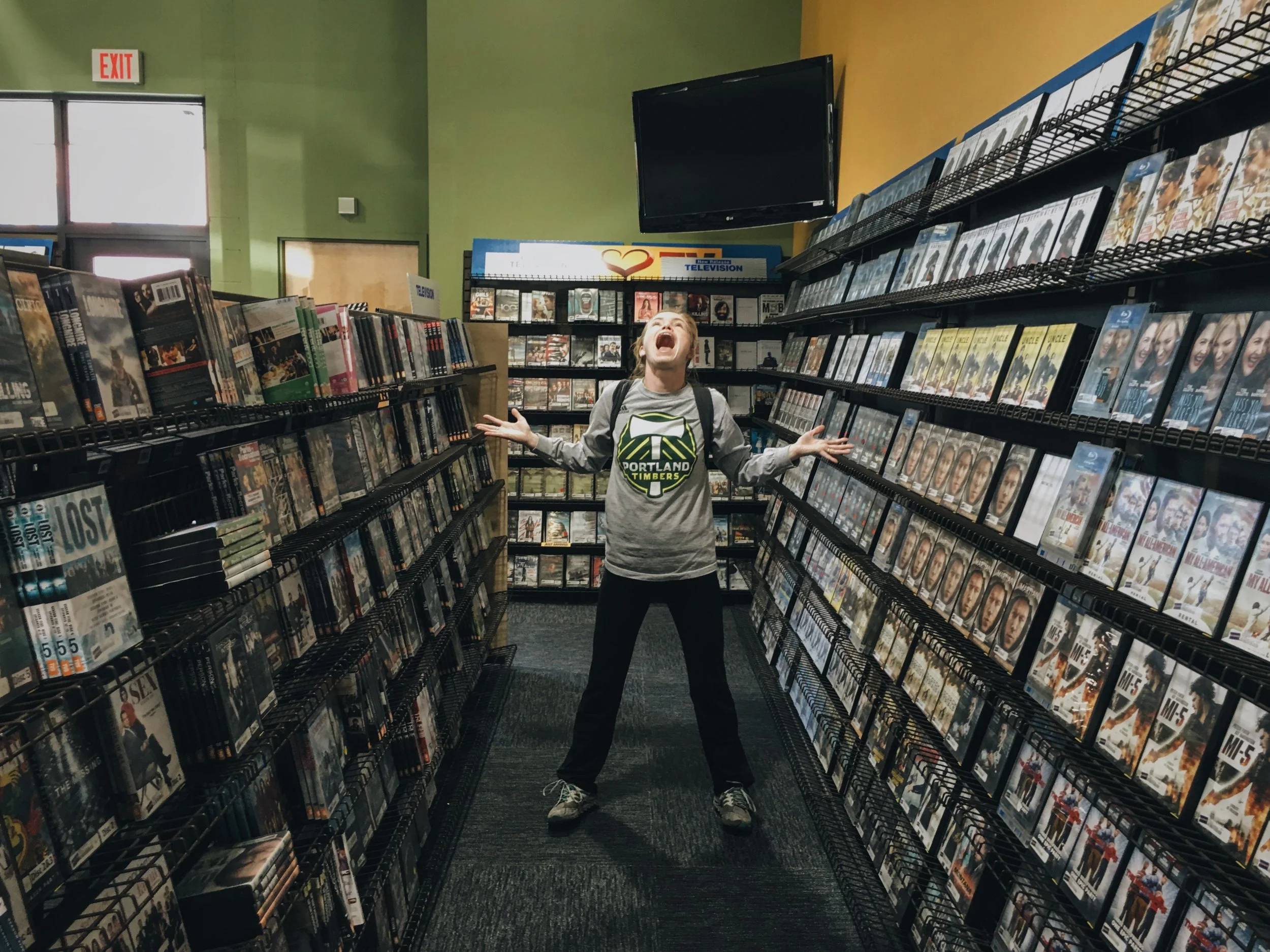
Back in the day, it was like a third of the shelves at Blockbuster. Who saw that coming?
Well, the entirety of Blockbuster did disappear, so there’s that.
There are plenty of logistical explanations for why this happened. Comedy doesn’t translate as well as adventure to an international market. Things got expensive and studios try to play it safe. It’s hard to be funny when you can’t take risks. Streaming took over.
And sure, these all probably played a role, but the explanation that feels truest to me is: we started taking ourselves too seriously.
A few years ago, I started taking improv classes so I could make the world laugh again and fix everything that was wrong in the world.
Okay, not exactly. I did it for me.

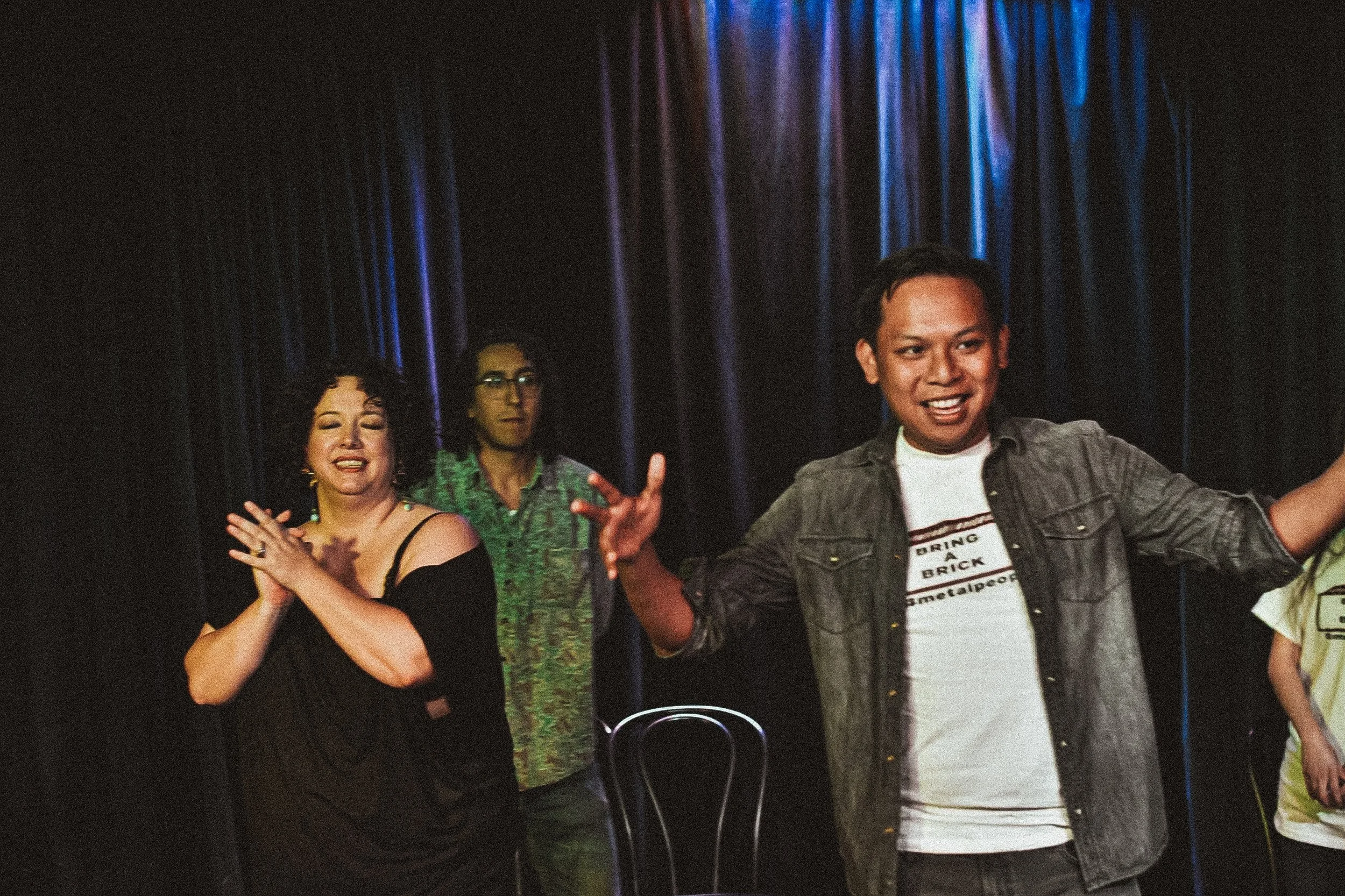
My day job in climate activism often had me on stage talking about some pretty heavy things, and while I enjoyed the meaningful work, I realized the more lighthearted and goofy side of me wanted to get on stage too.
I loved improv back in high school and college, and as soon as I started getting back into it, I started questioning why I ever stopped. I loved my teammates. I loved the challenge.
Improv is this weird activity. Because on one hand, what you’re doing is pretty ridiculous. You’re playing silly games to warm up and create silly scenes that don’t always go the way you expected. They’re not supposed to! At the same time, all this is weirdly good for you. A lot of people note how improv gives them some confidence, interesting insights, and muscle memory for life skills that are valuable off the stage.

At the same time, it can also be a bit like a drug. When you have a real good improv performance, it’s an incredible high. You want to get to that again, keep chasing that dragon. On the other hand, not all your shows are like that. Even if you’re very good, some of your shows end up being duds, in which case, you end up wanting to get back out there again soon to chase it down.
Either way, you find that you keep coming back to the stage.
I’ve been coming back over and over for a couple of years now.
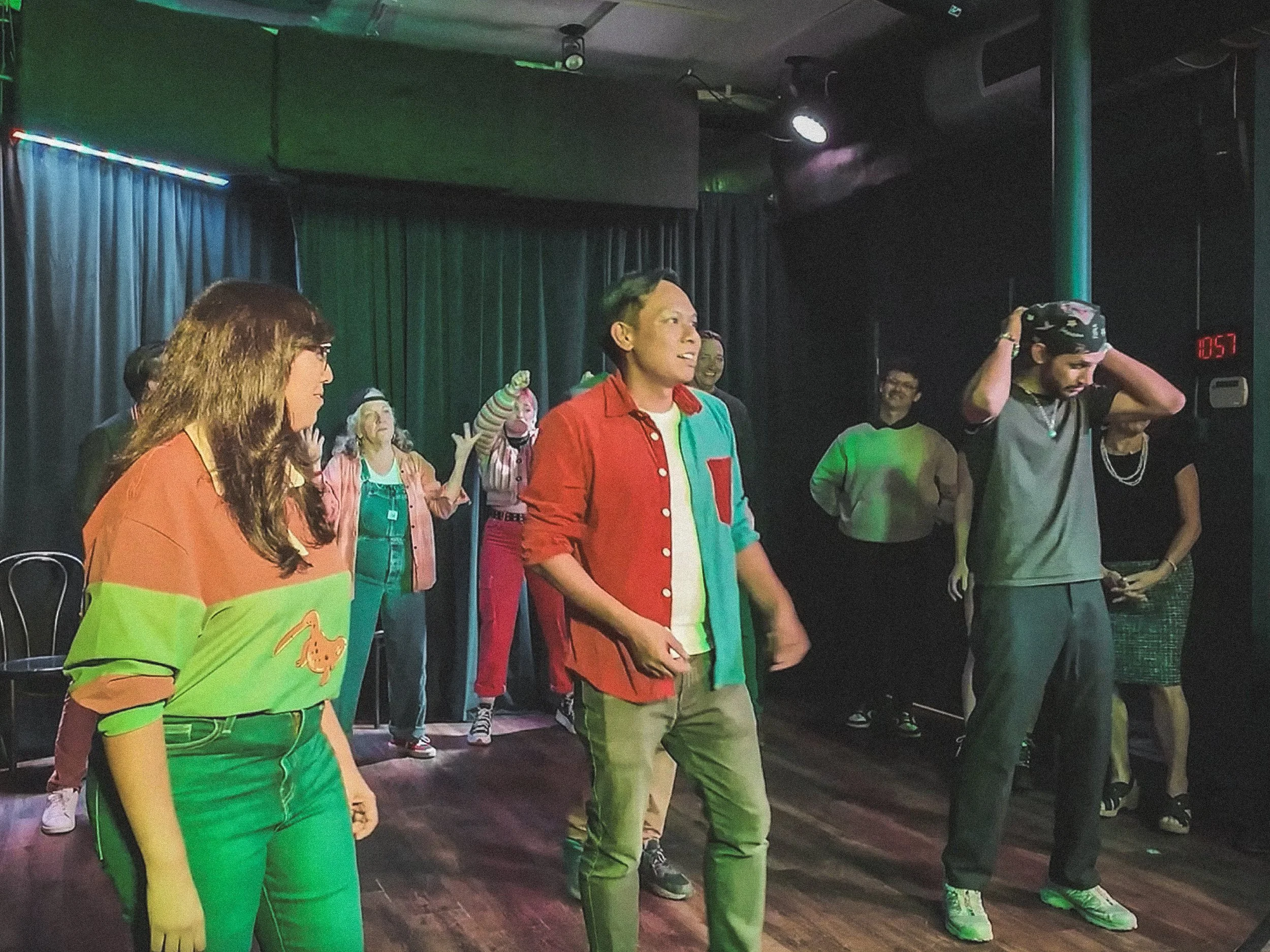
I made it on to a house team at my local theatre, which means I perform at least every other week, but often more.
I also started taking up freestyle rap improv, which is a totally different animal. Tough but fun.
And I’m happy to report that I’ve solved the world’s problems by being funny.

Okay, not exactly. But I have met some really great people. I enjoy getting together with improv friends and being silly together.
And that’s something.
What, with all this talk of loneliness epidemics and third spaces and community and isolation.
That’s something.
A funny thing happens when you have a bunch of friends in the comedy world. You catch yourself paying attention to the craft, be it standup, sketch, or improv.
You start to pick apart scenes and jokes, trying to figure out what works. You try and engineer humor. Of course, this kind of kills the joke.
But it’s like that frog you dissected in seventh grade. A sacrifice in the name of science.
We’ve been living in an unfunny era for quite a while… despite what people who leave comments with a dozen 🤣🤣🤣🤣🤣🤣🤣🤣 emojis might think.
But I’ve realized a few things.
I’ve learned that in order to share a laugh with somebody, you need to have a context that’s agreed upon. It requires some shared reality.

Safety and a shared reality are actually two things that are in short supply around the world.
A couple weeks ago, I went to see The Naked Gun in theatres. As a rare comedy in-theatres, I wanted the movie to do numbers. And it was a pretty good one. The Lonely Island and Leslie Nielsen have such distinct senses of humor, and it somehow bridged the two pretty well. A few weeks later Freakier Friday also came out.
Maybe these are safe picks for movie studios, with a built-in nostalgic audience to prevent a hard loss.
Or maybe it’s a start. A bridge back to some shared reality we can make light of.
Maybe, I’m not the only one ready to loosen up and laugh again.
At the risk of hyperbole, I think the environment that allows humor to thrive overlaps with a world I’d rather live in. A world we need to keep building.
One where we can see different points of view, to see the humor and humanity.
One where we aren’t taking ourselves too seriously. One where we aren’t punching down, knowing that ego gets in the way.
At the very least, we’ll share a few laughs.
And I said
How about
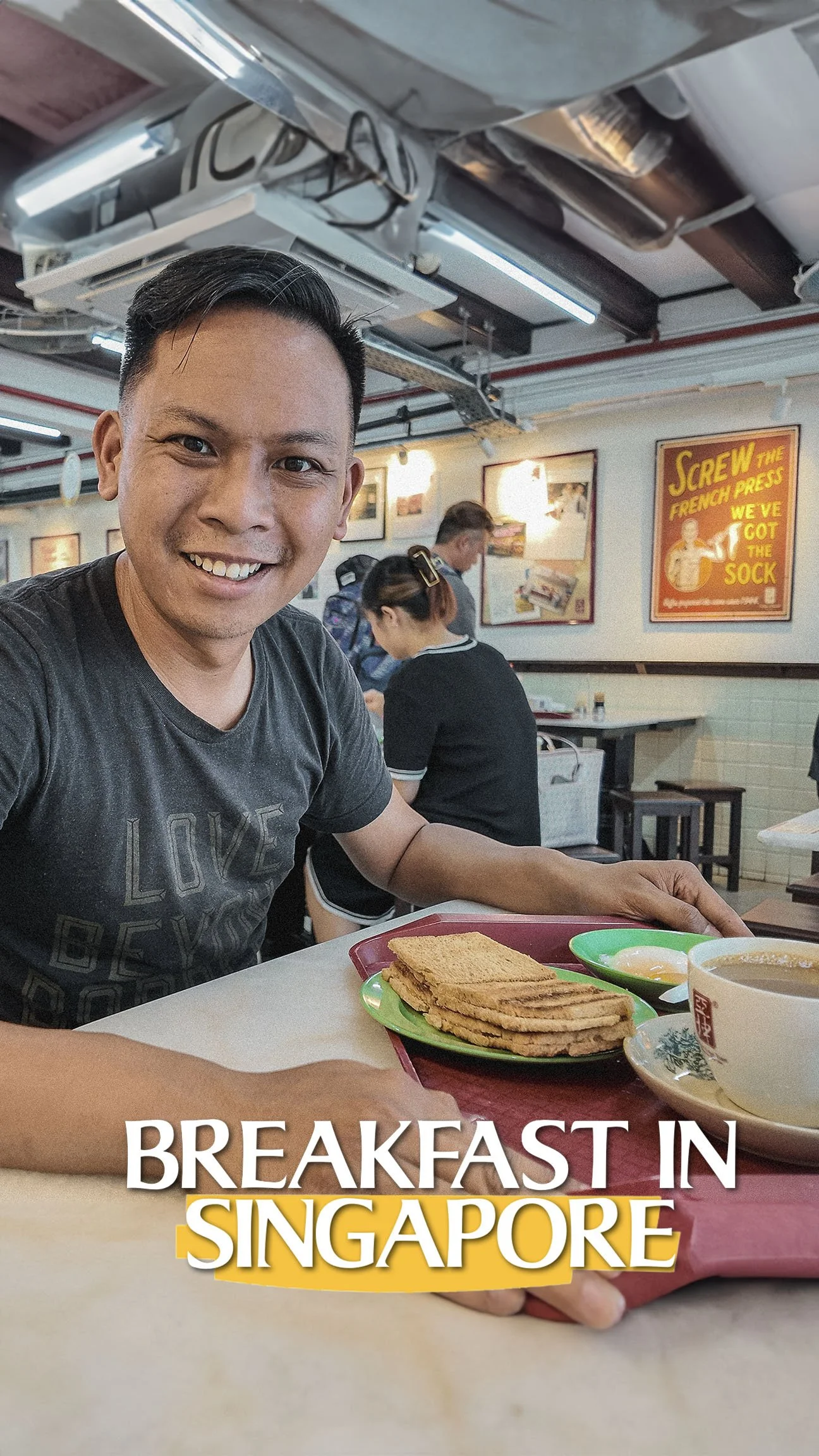
Breakfast in Singapore
She said
I think
I’ll get kaya toast
As I recall,
I think
We both kinda liked it